
10 June 2022
Interview with Harish Mehta about his book Maverick Effect for Hindustan Times
Interview: Harish Mehta, author, The Maverick Effect – “Technology is like bottled lightening”
1. What made
you write this book?

India’s economy has ballooned in the last few decades, and the seminal role played by the IT industry, which contributes almost 10% of the country’s GDP, has not been properly acknowledged. Noted professionals, industrialists and even bureaucrats have written books but none mentioned its contribution, or the contribution made by NASSCOM in fuelling this growth. Even seasoned economists only credit the economic reforms of 1991, unable to explain how these reforms arrested the downward spiral our economy.
The reforms did
help to make the business environment more conducive, and almost all sectors
grew – but no other industry matched IT. It was a technology-led revolution,
and this success was an outcome of what we did at NASSCOM – some of which were
getting the government to understand how IT would transform the world and the
opportunities it gave India; working with IT companies to embrace global
practices; building brand India at various levels. It was a structured series
of monumental tasks.
Someone had to play the role of the historian and set the
record straight!
2. What has
been the social and cultural impact of the IT revolution?
The Indian IT
industry employs 5.3 million engineers, and earns foreign exchange of around
$160B. In some countries, growth and riches are divided amongst the king’s
family or a few large companies. But in an IT company, about 70% of expenses
are employee-related. These jobs give a high disposable income which allows
employees to expand their imaginations and wings. The second-order effect
has been humongous. It’s the IT jobs that gave the real-estate sector its
biggest boost. Our airports needed to be expanded because of the global reach
of our business. Our campuses and infrastructure gave a boost to many businesses.
In the past, to get
a job you needed to know someone. In IT, if you get through the standard
recruitment test, you get the job. This seeded a meritocratic revolution as
India Inc started following our standards.
It's not just
meritocracy we introduced but also a new era of gender equality. Today the IT
industry has 37% women employees: almost two million women delivering great
outcomes and earning a good income, enjoying freedom at work and freedom at
home. Imagine the cultural change as these women bring up their families and
inspire the next generation.
Industry players
also set world-class standards of corporate governance and transparency
standards in financial reporting – these built trust in India Inc and
opened the gates for FDI money.
As for my friends who
run MSME/SMEs, most lament about the government regulations crippling their
growth. The only way to do business was by bending the rules. Subsequent
generations who inherited this environment assumed it was the only
way. However, the changes around them have encouraged young entrepreneurs
and smaller companies to start doing things differently.
3. Do you
have a message for the new generation, the start-up people who are building the
unicorns?
I admire this
generation – they are fearless, imaginative, and confident. And they have the
potential to change India faster than any of us can imagine. Technology is like
bottled lightning, and they have the capacity to bring it out and use it to
create solutions.
They are also lucky
to inherit an environment that can enable them to solve the problems that have
been plaguing us as a society!
Of course, I’d like
to caution them. I see many young ones chase valuation and not values. They
should chase both and never focus on one at the cost of the other.
I also feel that
they are too hyper-focussed on their respective businesses. At NASSCOM we saw
success differently. Each of us spent 10% of our time working for the ecosystem
– contributing to the industry, or to India. I believe this allowed us to
deliver a CAGR of 30% over the last 30 years. We knew that if the size of the
industry pie grew, our slices would get bigger too, and that’s the way it
turned out. When you think like that, your approach to solving problems is
markedly different.
People in today’s
start-up space have to understand that building trust with competitors, as well
as among stakeholders, from employees to government, will help accelerate
growth.
4. Respect
for intellectual property and an anti-piracy feeling comes out strongly in your
book. Is that an Indian tradition?
In India, we
believe in sharing knowledge freely. Our epics like the Ramayana and
Mahabharata are free. Everybody uses our ‘zero’ without paying royalty. IP is a
western concept, one that the IT industry had to buy into.
In our early days
at Hinditron, when we travelled abroad to try and sell our services, our
prospects would look at us as if we were thieves. They would not give us
business because they suspected we would sell out to their competitor for a
higher price.
We knew that unless
India respected copyright, the world would not recognize us as a
business-friendly nation. NASSCOM lobbied hard to amend the Copyright Act 1957
to include software with some tough conditions. When the modified act (even stricter
than the UK laws) did not prove as effective as we had expected, we recommended
that software piracy be treated as a criminal act. The new Copyright Act of 1999
carried a seven-day jail term. These actions sent out a powerful message across
the world: India was serious about the software business and IP. We became a
trusted nation to do business with. And this stance has been one of the
advantages we have over China.
5. You’ve
written about the influence of Jain teachings such as Anekantvad on your life
and work, can you give an example not mentioned in your book?
I’ll tell you about
an incident that took place at a customer site in the 1990s. My company,
Onward, produced ALPM (Account Ledger Processing Machine), a single desktop
which did simple data processing. We had shipped a large number of ALPMs to the
Bank of Baroda and many other banks. BOB was now ready to step up to the next
stage of automation, but there was resistance from the labour union. The
negotiations continued for some months. One day CIO K Kannan – later MD and
Chairman of BOB – asked if I would be willing to attend the next meeting to present
industry’s views. He told me that the demands were simple:
automation should not result in layoffs or loss of increment, plus a few minor
points, all of which the management agreed to. However, they were still
refusing to sign.
I remember that meeting vividly – a huge table with thirty
or thirty-five people on either side, with management sitting across from the
union members. They talked and argued, and I sat quietly and listened. There
was no unresolved issue, but the aggression was tangible. After some time, I
got up and went around the table and sat next to the union leader. He looked at
me suspiciously and asked curt questions. “What do you want? Why are you here?
But you represent the management!” I explained that I represented customers of
the bank, and those were essential to both management and union. That broke the
ice, a relaxed discussion followed, and the agreement was signed. This is an
example of something I was trained in at an early age – the Jain philosophy of
Anekantvad which encourages you to take a non-egoistical view of things, to
look at the other person’s point of view, and when in doubt to choose the
higher common good, because there is no such thing as absolute truth.
I have also
benefited from other concepts of Jainism. Aparigraha is the law
of detachment. When I had to give up my place as MD of Onward, my son
was selected by the board to replace me. He was still in his mid-thirties, and
I was criticized by many and warned of sombre consequences! But it was the
right time for the younger leaders to take over, and I found it easy to give it
up. Similarly, Sweekar – acceptance – has helped me through the tragedies of my
life.
6. In an
interview about the autobiographical aspect of this book, you said it was like
taking the risk of walking naked on the streets. How did that turn out?
I’m enjoying being
an author. Many from the industry, some critics, and quite a few strangers,
have written to me praising the book. Seeing your book at the bookstores
gives you another high. Traditionally, we Indians have never really valued
writers, and I would like to contribute as a change driver in that
transformation too!
The other day my
daughter-in-law’s friend came to talk to us about the book. While we were
chatting her phone rang, and she stepped aside to take the call. We heard her
say, “I can’t talk to you now, I’m having wine with an author!”
That felt good.


31 March 2022
08 March 2022
Judge books by their covers, says Saaz Aggarwal

Saaz Aggarwal is a writer and artist based in Pune, India. Her body of writing includes biographies, translations, critical reviews and humour columns. Her books are in university libraries around the world, and much of her research contribution in the field of Sindh studies is accessible online.
The Prince and the Pauper. I loved it, still have it, fished it out and realised from ‘After the story by Mark Twain’ on the title page that it was an abridged version – Ward, Lock & Co., Limited, London and Melbourne… surprisingly the year of publishing is not mentioned but I would have read it when I was seven or eight – late 1960s.
The first book you wish you'd read?
Sea of Poppies by Amitav Ghosh … I’ve been eager to read it for SO long and it’s been on my bedside shelf, waiting, but…
Your hands-down favourite writer?
Kurt Vonnegut <3 absolutely no comparison
A genre you're partial to?
Literary romances
A book you outgrew and grew into again?
Love of Seven Dolls by Paul Gallico
A classic you'd like to have written?
The Hitchhiker's Guide to the Galaxy by Douglas Adams
A character you wish you'd met?
Darcy (of course).
An author you want to meet on the other side?
Eiji Yoshikawa, I never got enough about Musashi.
Inside jokes or references that found their way into your writing?
I like to channel Stephen Fry and Spike Milligan.
Your most unconventional workspaces?
For several months the lobby of what was then called National Hospital, while waiting for my daughter to finish school across the road. This was really long ago and I was writing on a notepad – with a pen! It’s Hinduja Hospital now and probably not that easy to gain entrance into. I’ve always worked at airport lounges and waiting areas too, while waiting to take off …
As you work, you listen to?
My inner yakking only! It doesn’t matter what’s playing or even if there’s a big racket with people shouting or construction happening… I can’t hear it. One of the precious gifts of my existence.
The book(s) you've gifted most?
On Two Feet and Wings by Abbas Kazerooni
Mukund and Riaz by Nina Sabnani
and of course my books :)
Laurie in Little Women.
If you were in a murder mystery, your choice of weapon would be...
Poison, of course!
Book covers are...
to judge a book by! I make as much effort on the cover of my books (erm... almost) as on the text.
A book-based movie you liked better than the book?
Gone with the Wind
A female character you think an author did disservice to?
I can’t think of a single one since it’s many years since I read James Hadley Chase but in college I devoured every one that my local lending library had and the women were really sad, shallow characters, one and all!
A woman or girl in history you wish had got a different ending?
Erm... Sunanda Pushkar maybe?
"There are no bad books..." -- your take?
11 July 2021
Keeping in Touch by Anjali Joseph

A writer's life
Saaz: What got you started with writing this book?

Anjali: I was chatting to a friend in Norwich some time in around 2014 and she said she was terrible at keeping in touch. The phrase hovered in the air, illuminated for me, and I went home and wrote it down, convinced I’d write a book called Keeping in Touch. That was also the year I moved from Norwich to Guwahati in search of a new adventure, both at home and very much not at home, but fascinated by Assam. I had the character of Keteki in mind for a while as I was finishing The Living, and had even started writing about her, but Ved came along a little later, in 2015 when I wrote a short story that turned into the opening chapter of the book. The lightbulb called Everlasting Lucifer was a short story I’d begun writing when I was about eight years old, and not finished.
Saaz: And the symbolism of that lightbulb?
Anjali: Maybe it’s some form of the light that’s in everybody. Maybe
a sort of objective correlative of something that is much bigger. Besides, each
of us wants to light up. But maybe the prospect is also a little threatening.
What would really happen if that light were seen?
I don’t know where the name came from. I was reading a lot of F Scott Fitzgerald at
the time, The Diamond as Big as the Ritz and several other of his
stories. I must have at that time or sometime earlier learnt that Lucifer meant
‘light bearer’ or read about the story of how Lucifer was the fallen angel, but
that it’s not necessarily a pejorative name. It was there as one of those ideas
and half-ideas, some of which you write down and some that remain at the back
of your mind.
Saaz: Did your characters change as you wrote?
Anjali: Well, they meet at a time in their lives when they are ready
for change. Their encounter is the catalyst that makes them step outside the
comfortable shells they have created.
Both of them evolved as characters in the way I wanted to
show them. My friend, the wonderful writer Tim Pears, was kind enough to read a
draft and from his responses, I realised that the initial iteration of Ved was
too off-putting, and Keteki a little too oblique.
At the opening of the book, Ved is a toxic bachelor, but
he’s also in coming to the end of a time of getting over his earlier geekier
self. He’s enjoying a period of his life when he feels he can be in control.
But obviously he’s also still at least in a latent way open to the possibility
of more. And then he falls for her. And Keteki – I had to say more about her in
subsequent drafts; initially I wanted to show her mainly through the effect she
had on other people.
Saaz: Your books have always run quite close to
your own life adventures.
Anjali: When a child growing up in a provincial English town I was
waiting to start my life, the fiction that I read was about all sort of things and
these novels almost seemed to be carrying messages, telling me, maybe your life
will be like this! Or maybe it will be like that! I drank it all in. In a way,
reading fiction is a way of thinking about how to live.
Now I get interested in one thing after another, and
sometimes that’s what my next novel will be about. Maybe the other things that
I’m learning around that time also become relevant. But I wouldn’t say most of
my life goes into my novels. There are lots of things I do and read about that
don’t directly feed into what I write.
I suppose for me, writing a novel is partly about finding
out more about the characters and place I’ve decided are interesting. But it’s
also a process of becoming the person who will have written the novel I’m
writing. It’s something that gets revealed as I go along. Each individual step
is in the dark, but there is a kind of feeling of what the next thing is.
Saaz: Why Assam?
Anjali: When I went to live in Guwahati in 2014, Assam was a new
place for me. I started learning Assamese, a beautiful and elliptical language.
I think there might be a flavour of that in the book. After a while of
studying, I realised that being able to say what you mean in Assamese hardly
means you can speak it. That is not how Assamese is used. As I wrote in an
essay for Unbound, most people say something indirectly
related to what they mean; the person they are talking to then responds by
saying something indirectly related to the first thing.
I had two lovely teachers of Assamese, Dimpy Deka and my
friend and neighbour Babu’s grandmother, Bimal Rajkhowa, herself a writer and
lyricist. My Assamese remains halting but I can read and write, and some of my
learning comprised reading aloud books in Assamese and asking about the phrases
or words I didn’t know. It was a beautiful introduction to a sensibility as
well as a language. The culture of Assam has so much depth, so many layers.
There is a certain way of seeing life. It was just lovely to live there. And in
Assam, everyone is a reader, it’s a place where people understand books and
literature. In Bombay or Bangalore or Delhi if you say you’re a writer people
will ask whether you know this writer or that writer, or if you’ve written for
films, things like that. But in Assam people will want to tell you about what
they’ve been reading. I’ve had conversations like that with a taxi driver, the
man who works in the gas agency. Everybody is excited about reading, and for a
writer that is truly special.
Saaz: And your book has such a strong yoga
component too!
Anjali: Well, I had a scientific, post-enlightenment sort of
upbringing. In my family, there was not much ritual or religious observance. Still,
as a child I was fascinated by religion, magic, and wonder. I’d read a
storybook and hark back to the missing word in a spell, thinking, one day I’ll
find out what that word is! And then I’ll be able to be invisible or do
whatever the spell was for. That interest in spirituality found its expression
much later, in my thirties, when I did a yoga teacher training. And there we
studied Vedanta and some yoga philosophy: that was the first time I felt, here
is a description of the world that makes intuitive sense to me.
Yoga training, then learning about tantra, were ways into
these systems of thought. It was kind of liberating. And of course, if you are
a fiction writer, you can use that fiction to offer people the idea that
reality might not be quite as monolithic and quite mechanically materialist as
we – certainly my generation – were told when we were young. The idea is
important to me and the book is sort of soaked in that.
Saaz: The uses of a novel, then?
Anjali: I believe in the novel as a machine that can re-configure a
reader’s way of being in some way, perhaps for more lightness, or just more
joy. Imagination can bring us back to ourselves, and that’s something I’m
always aiming to do. Here I wanted to take the reader, while reading about Ved
and Keteki, through the idea that in some ways the past is imaginary, and its
weight that we have been carrying can be exploded into lightness. I don’t
necessarily see ‘enlightening’ as a one-off process after which one transcends
and everything is bunnies and angels. I think it’s part of human experience
that there is an intermittence to keeping in touch with that real self inside,
as well as with others and the way we really feel for them. It doesn’t matter
that this awareness drops; we can pick it up again, and that’s the process of
keeping in touch which also enables compassion, for ourselves, and for others.
Saaz: Your life has centred around writing
since a very young age but in your books you come through as someone who has
led many lives through others. Knowing what you know now, would you have chosen
another path?
Anjali: I didn’t really choose writing; I just always knew that was what I would do. And as you say, in a way through writing I can do anything else I like.
First appeared in the Hindustan Times books page on 10 July 2021
03 July 2021
Colaba The Diamond at the Tip of Mumbai by Shabnam Minwalla
Shabnam's vale of serendipity
 It was an online talk in which the author presented some of its
intriguing photos, experiences and learnings, that led me to this book. Her discoveries,
couched in the easy wit and bubbling energy so compelling in the talk, were just
as much of a pleasure to read.
It was an online talk in which the author presented some of its
intriguing photos, experiences and learnings, that led me to this book. Her discoveries,
couched in the easy wit and bubbling energy so compelling in the talk, were just
as much of a pleasure to read. “What Colaba doesn’t have is easy to list. What Colaba does
have, is not. Its qualities are concealed by voluminous skirts and peeling
paint,” writes Shabnam Minwalla, and proceeds to treat the reader to a
comprehensive expose, weaving personal experiences from a range of people
interviewed, with widely diverse secondary sources.
The latter include facts and administrative data from Gazetteers;
iffy maps and exaggerations from travellers’ accounts; colourful descriptions
from novels; even gravestone epitaphs (“doleful postcards from the past”). The
one I enjoyed most was an August 2002 Busybee column which lampoons the
Arabs who for decades holidayed in Colaba to revel in rain, a novelty rendered
anachronistic by global weirding. The exuberant snippets provide information,
they create atmosphere, and their depth and diversity well represents contemporary
Colaba, a place whose character transforms from corner to corner, sometimes
quite dramatically.
As for the people interviewed, most are long-term residents
and colourful neighbourhood characters. The best stories come from the author
herself, memories of Colaba haunted houses, lingerie shops that date back to before
the word lingerie arrived in Colaba, glimpses of a prim schoolgirl, one of a
horde, who transformed into hoydens tumbling down the staircase the instant the
evening bell rang, only to be harangued on the way home by the fierce battleaxes
of Cusrow Baug. Biographical details are introduced not in a self-congratulatory
or coy manner or even in bland lists, but in a festive jumping-about that
interweaves energetic adjectives, provides vivid pictures, and sometimes has you
laughing aloud. The creative happiness is impressively balanced with deep,
fault-finding, nit-picking research into this unabashedly grimy district of
India’s financial capital.
Colaba has no medieval fortresses, tales of tragic queens,
or echoes of bloody battles. Just two hundred years ago it was a
jackal-infested island – fine-grained diorite, composed of feldspar and
hornblende! – separated from the emerging metropolis by a temperamental creek,
ghastly shipwrecks, and a cemetery greedy for colonizers. When a causeway was
built, the inconvenient outpost transformed into a place of buzzing industry,
and the malodorous creek with mosquito-riddled mangroves and criminal-infested
bays was eventually replaced by traffic-choked streets lined with art
galleries, cakeshops, and more. Who doesn’t love Colaba for its street shopping
– those cool, billowing cottons, coolly-replicated designerware? Amidst the
thronging crowds, familiar faces pop up and cheery “Hieee!”s ring out in
Shabnam’s vale of serendipity, the place of which one well-known resident (read
the book to know who) is reported as having instructed, “When you go shopping
down Colaba, Ma, don’t forget to give everybody my love.”
Besides the extraordinary energy of the haphazard streets of
the southernmost tip of a city rapidly sprinting northwards, this book also documents
nooks and structures: Colaba Lunatic Asylum, Royal Alfred Sailor’s Home, the
garden of a Mrs Hough and its magical mango tree which fruited twice a year;
the reincarnation of Buckley Court from a haunted Indo-Saracenic mansion to a
guesthouse packed with fascinating residents to a ‘luxury skyscraper’;
dragonflies fluttering by enroute to East Africa. And the fascinating stone
which clarifies the boundaries between Colaba and Old Woman’s Island of yore –
inside a residence encroaching into, of all places, the trendy and laidback Colaba
Police Station.
When I called Shabnam Minwalla to tell her how much I had
enjoyed her book, we naturally compared notes and, though we’ve never met, and even
claim different territories of Colaba, found much to celebrate.
Colaba is still somewhat in the nature of ‘native place’ to me, the venue of childhood winter vacations escaped to from bone-chilling frost, sultry evenings strolling on the Cuffe Parade promenade, playing in the piles of rubble waiting to take their place in swanky buildings, snacking on peanuts and sometimes even illicit bhel (because typhoid). “Which building?” Shabnam asked and when I replied, she knew exactly which one, and together we moaned the decaying grandeur and eventual demise of the townhouse with its authentic stained-glass windows, Minton tiles, sagging wooden staircase and unpolished banisters, residence of former presidency magistrate KJ Bijlani for nearly fifty years.
Every chapter of this book ends with a pithy ‘Colaba lesson for life’, and the one I’ve picked to pass on here, one that sears me with regret, instructs: “Quick! Talk to your grandparents before it’s too late.”
16 June 2021
Wall Paintings of Sindh by Zulfiqar Ali Kalhoro
Secret treasures
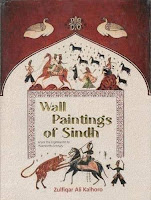 In India, Sindhis are most often seen as a
mercantile community – hardworking and enterprising, but almost entirely
focussed on material gain and pursuits, with limited interest in art and
culture. Sindh itself, the ancestral homeland which the Hindus left after
Partition took place in 1947 and to which they have almost no access today, is
seen as a hot and dusty place of limited opportunity. So this book is a real
eye-opener which showcases a very unexpected dimension for Indian Sindhis to
understand something about their lost heritage.
In India, Sindhis are most often seen as a
mercantile community – hardworking and enterprising, but almost entirely
focussed on material gain and pursuits, with limited interest in art and
culture. Sindh itself, the ancestral homeland which the Hindus left after
Partition took place in 1947 and to which they have almost no access today, is
seen as a hot and dusty place of limited opportunity. So this book is a real
eye-opener which showcases a very unexpected dimension for Indian Sindhis to
understand something about their lost heritage.
In 1998, early in anthropologist Zulfiqar
Ali Kalhoro’s career, a field visit took him to the necropolis of Mian Nasir
Muhammad Kalhoro, where he saw many beautiful paintings on the exterior and
interior walls of its monuments. He could see that they were crumbling and in
urgent need of restoration. Feeling overwhelmed by the beauty of the art around
him, feeling equally disturbed that it would all soon be lost, Zulfiqar
resolved that he was going to travel all across Sindh to seek out every other
similar site he could find, and record whatever he saw in them. This book is a
result of many fulfilling journeys the author made over more than 20 years, to
do so – and a great gift to people who are interested in the history of art,
and in particular the history of the art of Sindh.

What I learnt from this book is that Sindh
is strewn with monuments of many kinds and these include tombs, places of
worship, and palaces. Most of these are filled with works of art, and besides
architectural flourishes, ceramic embellishments and tiling, many of the walls
are covered with paintings too.

In many places, Zulfiqar Ali Kalhoro noticed that in the process of maintenance of the tombs by their followers, they were whitewashed on the inside, and the paintings were damaged. For example, in the tomb of Mian Yar Muhammad Kalhoro in Khudabad, Zulfiqar found it all whitewashed except for some paintings which may have required too much effort to reach. From these traces, he deduces that
“the whole interior of the tomb was adorned with stylized flower vases, fruit dishes and a variety of flowers covering every panel, soffit, niche, squinch and arch recess of the tomb.”
His research indicates that the art was a
tradition of long-standing, but very little of what was created before the
seventeenth century remains and this book largely covers art of the Kalhora,
Talpur and British periods of Sindh’s history. Many of the previous era, glimpses
of which sometimes pop up in historical records, no longer exist.

Royal tombs, Zulfiqar points out, are not embellished with figural motifs, except for birds. They carry gilded Quranic verses in striking calligraphy; traditional geometric patterns; and floral, vegetal, plant and tree motifs. The lily flower, Zulfiqar points out, is a favourite motif of the Kalhora artists in both paintings and glazed tiles. Zulfiqar also explains the symbolism of other favoured motifs such as the cypress tree, and varieties of birds and flowers. Monuments of other rulers and saints, however, carry all kinds of figural depictions including scenes of a bird feeding its offspring, rooster fight, mourning scene in a tomb, action-packed animal fight scenes, hunting scenes and battle scenes, as well as representations of cultural activities, such as dance, music and sports, and many romantic folk scenes. In all, they provide a rich illustration of the social and political life of Sindh. There are even tombs which also show domestic activities such as dancing, cooking and churning, such as the tomb of Othwal Faqir, located south of Mian Nasir Muhammad Kalhoro’s shrine. In fact, locations of each monument have been meticulously provided – a poignant resource for the many who may want to visit but are unlikely to ever be able to do so.


Most of these art treasures, Zulfiqar Ali
Kalhoro reports, are in sad repair. In the twenty years of his quest, he has
seen them decay before his eyes, under the ravages of extreme climate. It is
sad to think that in the decades to come, most will vanish, unrestored, and
live on only in the pages of this book. It’s not just the government which is
responsible for the neglect – but who can blame needy peasants who till the protected
land close the beautiful monuments to fulfil their simple needs?
What I learnt from this book moved me deeply. What I saw and read made me feel connected with a precious and distinctive heritage which has been frittered away and is only saved from complete obliteration by books like this one.

20 December 2020
BEYOND THE CARICATURE by Rajesh Pant

06 August 2020
Learning to read all over again
 When the
lockdown commenced, life turned grim overnight; stranger than fiction. I was
reading the Memoirs of Seth Naomal Hotchand of Karachi (1804-1878), a
well-told narrative of a wealthy merchant of Sindh. Being the elaborate
personal account of someone who belonged to a community about which not much
documentation exists, the book, with an interesting history of its own, is
fascinating. However, my eye lazed mid-sentence while my mind wandered, and the
pages stayed put.
When the
lockdown commenced, life turned grim overnight; stranger than fiction. I was
reading the Memoirs of Seth Naomal Hotchand of Karachi (1804-1878), a
well-told narrative of a wealthy merchant of Sindh. Being the elaborate
personal account of someone who belonged to a community about which not much
documentation exists, the book, with an interesting history of its own, is
fascinating. However, my eye lazed mid-sentence while my mind wandered, and the
pages stayed put.
In despair,
unable to read, unable to write, I dug into my files seeking comfort, and came
across Forgotten Stories from my Village, Harwai by Hari Govind Narayan
Dubey. In 2015, I worked with the author to translate this charming book, based
in rural India during the freedom struggle, into English. It has dramatic
stories – pots of gold uncovered by a farmer ploughing his fields, a
spectacular jailbreak, the impact of caste division and social boycott, and
more. What makes it a classic is the ringside view of the lifestyles, thought
processes, and other subtleties of an epoch of Indian history invariably
dominated by political figures with vested interests. To make it easily accessible
to all, I uploaded it for free download on this link .
Still
unsure about being able to concentrate, I decided to attempt a slim volume with
an uncomplicated cover: The Impossible Journey by James A Coghlan. This
lovely story of a Scottish boy’s experience of serving in the Indian army is
fiction, but, based on the diary of the author’s great uncle’s accounts of a
road journey from Rawalpindi to London in 1936, is quite as alive with engaging
detail as Naomul’s memoirs. Along with glimpses of world history and geography,
the reader understands a little about the connection between India and
Scotland, while revelling in the wry turn of phrase that permeates the book.
And then, a
drowning woman who miraculously began to swim, I picked up The Strange Case
of Billy Biswas by Arun Joshi. This book shows that IWE were quietly
turning out classic prose decades before the term IWE was coined. Billy Biswas
belongs to two peculiar and mutually exclusive communities: the privileged
anglophiles who once governed India, and an ancient tribe, both groups reduced
today to appendages verging on extinction. Though I found its traces of
schoolboy fantasy a little annoying, the plot captivated me and I read in long
happy bursts, freed at last from lockdown.
01 December 2019
Circus Folk and Village Freaks by Aparna Upadhyaya Sanyal

There are organs and organs
This attractive-looking hardcover book turned out to be a surprising treat. Each of its eighteen stories, all written in verse, are about people who are different. Not just different but significantly so, some quite peculiar, and the stories deal with different aspects of how the difference arose, how it was dealt with, and what happened in the end. Along the way, each story has earthy overtones. It starts quite naturally – I was surprised at first and then admiring, but as it went on and the bonking got more intense, I wondered whether it wasn’t just to say that people who are different are actually like everyone else – or that by virtue of their difference they are more highly sexed. Though the question occurred to me while reading, I forgot to ask it to the author when I had the chance. The former, I suppose, based on what she revealed of herself and her book through the discussion. Over the next
three weeks, she had written eighteen stories, waking every morning with new circus
people and village freaks performing various antics through which they conveyed
meaningful messages about human beings and the way we lead our lives. After a
rapid, fully-charged run, Aparna stopped and only looked at her stories two
months later: “The first thing I said to myself is, ‘You are sick!’ I could not
believe I wrote these stories.” (And her mother would moan, “Where did I go
wrong, was it I who filled such nonsense in your head?”) For Subramaniam had
turned out to be a ‘Crocodile Man’, a source of income but unable to gratify
his wife, who had to make her own arrangements. Pablo the Clown had a
‘foot-long schlong’ which women thronged to view and engage with. Vishu, the
Village Exterminator, came between a husband and wife in an unusual way.
Urvasi, the Devadasi, developed culinary skills that threatened to make the
entire village and its surroundings obese. Miss Rita, born a bonny, baby girl, developed
a ‘fertile chinny-chin-chin’ which sprouted a thick crop of hair. Murali, the
Metal Eater, is a reverse-Midas who eats and coolly digests metal:
Over the next
three weeks, she had written eighteen stories, waking every morning with new circus
people and village freaks performing various antics through which they conveyed
meaningful messages about human beings and the way we lead our lives. After a
rapid, fully-charged run, Aparna stopped and only looked at her stories two
months later: “The first thing I said to myself is, ‘You are sick!’ I could not
believe I wrote these stories.” (And her mother would moan, “Where did I go
wrong, was it I who filled such nonsense in your head?”) For Subramaniam had
turned out to be a ‘Crocodile Man’, a source of income but unable to gratify
his wife, who had to make her own arrangements. Pablo the Clown had a
‘foot-long schlong’ which women thronged to view and engage with. Vishu, the
Village Exterminator, came between a husband and wife in an unusual way.
Urvasi, the Devadasi, developed culinary skills that threatened to make the
entire village and its surroundings obese. Miss Rita, born a bonny, baby girl, developed
a ‘fertile chinny-chin-chin’ which sprouted a thick crop of hair. Murali, the
Metal Eater, is a reverse-Midas who eats and coolly digests metal: Sweet Murali, with a whistling throat and surreal digestion within –Never ate a bit of meat or gran, but gorged himself on mountains of tin
Of Sita and Gita, the Siamese Twins,
Who separated themselves in a bid to winLove, and for half a heart each, a home –
Instead, lost it all and grew old alone.
 This book
is hugely amusing but it’s also strewn with pathos. Its plots are inventive, and
the illustrations by Rachna Ravi, aesthetically pleasing, are a great lead-in
to each story. Most interesting, a stroke of genius I felt, was that while the
male organ is bandied about quite lasciviously, when female organs are brought
to the page, they turn out to be brain, lungs, liver and heart.
This book
is hugely amusing but it’s also strewn with pathos. Its plots are inventive, and
the illustrations by Rachna Ravi, aesthetically pleasing, are a great lead-in
to each story. Most interesting, a stroke of genius I felt, was that while the
male organ is bandied about quite lasciviously, when female organs are brought
to the page, they turn out to be brain, lungs, liver and heart.