

Sometime in mid-2012, I asked Niranjan Gidwani to tell me his
family’s Partition story.
Till then, I’d only known Niranjan as my husband’s friend, a
good guy, and never thought about him as a Sindhi or anything like that. But
I’d just started working on a book about Sindhis and it was amazing how all
kinds of unexpected sources were popping up. Niranjan told me some interesting
things, including how his grandfather, a fairly well-off and influential person
in Sindh, went missing in the turmoil before Partition. His younger son was
general manager of the Great Indian Peninsular Railways, and arranged for a
private bogey for the family to move their things as they left Sindh. However,
the labour bringing their furniture and personal belongings never reached the
station. Later, his grandfather's body was found cut up in pieces in a sack,
under a railway bridge. “Till today,” Niranjan said, “no one really talks about
this.”
This was the first example I’d heard of barbaric atrocity coming
out of Sindh, and over ten years and many interviews, it is still one of very
few. Even with no one really talking about such things, the extent of violence
in Sindh is of a completely different scale to what happened in Punjab where
there was no family without its own horror story. This is one of the big
differences between what happened in Sindh and what happened in Punjab, and
it’s the main reason why people who left Sindh always considered themselves the
lucky ones and did not feel they had a story to tell.
What somehow slipped out of this broad context was that while
Punjab and Bengal were split in two, Sindh was given intact to Pakistan. And when
the minority community Sindhis were forced out by ominous threats and pointed
discrimination, they had to start afresh in unfamiliar places among unfamiliar
people, where the food, clothes, habits were different from what they were
accustomed to – and the language was written in the opposite direction.
Many Sindhis settled in centres of employment and trade – Bombay,
nearby Pune, Delhi, and places easily accessed from the border including
Ahmedabad and Ajmer. Aruna Jethwani, 13 when Partition took place, remembers that
neighbours in Ahmedabad and Nadiad were good and helpful. However, before
renting an apartment, her father had to sign a declaration that no meat would
be cooked or eaten on the premises. Reaching out to touch laundry flapping on a
line one day, she knew what it meant to be an inauspicious omen when a woman
screamed, “Nirvasi chho – you are homeless!”
The taint of disdain was felt all over.
In Gibraltar in October 2013, Suresh Nagrani stood up to
speak after my talk. “When I was young,” he started, “I thought all Indians
were Sindhi.” Everybody laughed. The thing is, though, the Indians native to
Gibraltar are indeed all Sindhi. They form part of the trade diaspora that
originated in the 1850s, soon established itself in ports around the world, and
was documented as recently as 1999 by Claude Markovits. Suresh went on to
describe the jolt he got at university in England where he met Indians from
different parts of India – and one of them said to him, “Oh, so you are a
Sindhi. Let me ask you a riddle. If you meet a Sindhi and a snake, which one
should you kill?”
Perhaps the prejudice Sindhis faced began after Partition
when many of the homeless ones took to trading at low margins, creating
resentment among established traders. Perhaps this was reinforced by negative
characters in Hindi films who had Sindhi names and said nasty, exploitative
things in Sindhi accents – even until the 1990s.
Beneath that public perception lies a gentler reality.
Reyhaan Datta who grew up in Calcutta remembers a Sindhi sari seller from whom
her mother bought beautiful saris – a softspoken person whom her mother would
offer tea. One day he told them that it would be his last visit. He had been a
skin specialist and had left Sindh with his wife and mother with nothing but
the clothes on their backs. Selling saris from door to door and living simply,
he had now saved enough to buy a practice with a leading Calcutta skin
specialist.
It is stories of this type that pervade every family that
left Sindh.
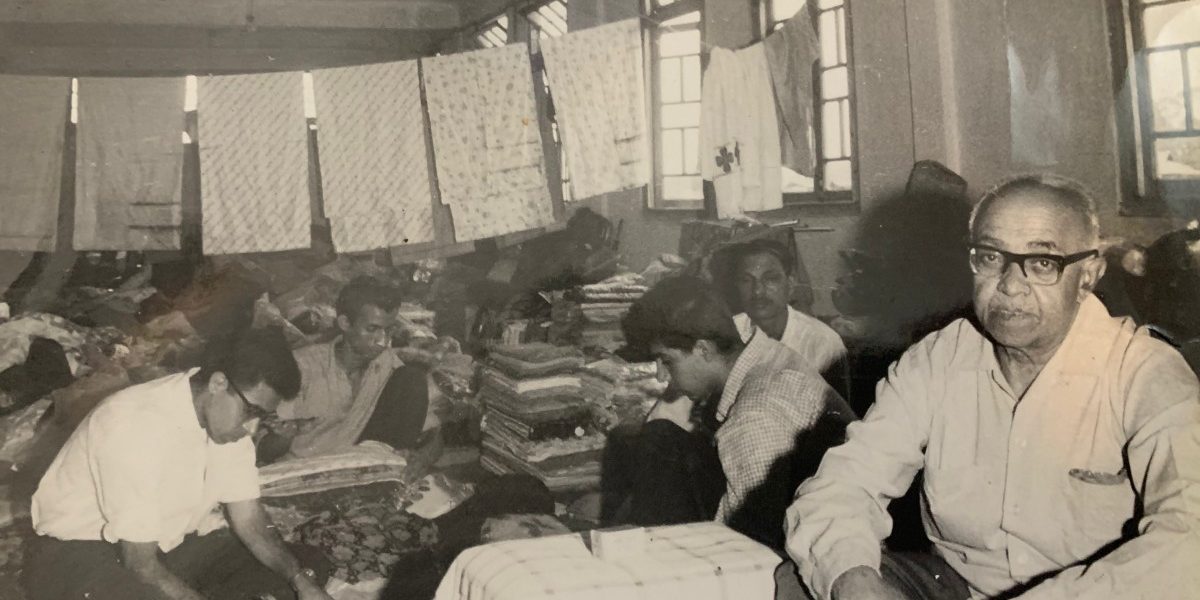
From the ‘refugee camps’ in which the new Government of
India accommodated the masses displaced by Partition came many schools,
colleges, other institutions that continue to serve the community. Being homeless, the Sindhis built
homes for themselves; in time, they would change the skyline of these cities. Scattered
over the globe with a few pockets of some density, the Sindhis rebuilt their
lives of comfort and dignity by integrating into the communities where they
settled. For a community that
lost all their material possessions, they were able to regain a remarkable
degree of prosperity in time. And, just as this heterogenous community
had behaved as one when leaving their ancestral homeland without looking back –
most families spontaneously stopped talking to their children in their mother
tongue.
The languages we grow up with, the words and expressions
used around us, influence our thoughts and behaviour. And the Sindhi of 1947
was a language packed thick with phrases and concepts from the region’s
philosopher poets of the previous few hundred years.
Herkishendas Melwani left Sindh in 1939 to work in the
global retail chain of Lalchand Dhalamal, was never able to return when exiled
by Partition, and settled in Shillong. Anglicized due to his social station and
education, Herkishendas valued his Sindhiness and quoted and lived by his Sindhi
pahakas (sayings). One day a fire on GS Road burnt down six shops and he too
suffered great losses. When asked, “Saba mey bhali – there is good in
everything – really?” He replied, “Yes, now even more than before. “Hikri lati
sau pati – when one door closes, another 100 open.” His son, Murli Melwani (PhD
in English Literature and a professor at Sankerdeb College until he too fell
prey to political forces and left his hometown Shillong, becoming a businessman
in Taiwan and later the USA, acknowledged recently by Sahitya Akademi as a
Sindhi writer who contributes to languages other than Sindhi) wrote about his
father’s classic Sindhi response here:
systematically restoring and recouping, adjusting losses against goodwill,
ensuring that credit lines remained open.
The Sindhi pahakas – shaped by and reinforcing the multi-faith
harmony of the land – defined the mindset of a people who chose to accept their
fate, protect their womenfolk, adapt to lives in other places. They continue to
pervade the Sindhi identity. Somewhat. Because there is no place the community
has access to where their language is spoken on the streets. Sindhi is a
language that you only hear in the homes of relatives, it’s the language of
intimacy, of the lost country. It is the language you hear your grandparents
speak to each other and to those of their children who knew Sindh – never to
you. Because you had never known Sindh, and it would be impossible to explain
anything as important, as essential, and as complicated as that.


No comments:
Post a Comment