13 June 2014

Outlook Bibliofile 16 June 2014

What is a critic but one who reads quickly, arrogantly, but never wisely? 

David Mitchell, writing in Cloud Atlas


For a few years I wrote a weekly book column for Sunday Mid-day, Bombay’s most wonderful tabloid. It was one of the most enjoyable assignments I’ve ever had. The perks included a never-ending supply of new books, and junkets to the Jaipur Literature Festival (that Disneyland for the reader).
Among the negatives was horror at the growing number of mediocre books that the combination of new technology and a lack of discernment were conspiring to produce. Another problem I had was that readers quite often complained that they didn’t enjoy my reviews, because, they said, I only ever praised books. Apparently, mean, nasty reviews are much more fun to read than positive ones, and one can build a much more attractive reputation as a reviewer if your reviews are dripping with wit and sarcasm. Sometimes people even asked me whether authors and publishers paid me to write good things about their books. So I would explain (trying to hide my indignation) that they did not, but that I saw no point in writing about books that I hadn’t enjoyed reading.
I hardly ever condemn a book, even if I hate it, because there’s no accounting for tastes and something I dislike could well be liked, enjoyed, and may even be admired by someone else. There’s only one book on this blog with a ‘burn’ rating – Culture Shock! India, and it is in fact a popular book which scores of hapless visitors to India refer to, perhaps even with deference.


08 June 2014

The Last Wave by Pankaj Sekhsaria

Island Purgatory

The Last Wave is set in one of the most beautiful, pristine places on this earth. Its primary characters are a young man and woman – a gentle, sincere, capable pair. We travel with them through the Andamans, experience its complex environment, its many distinct and exotic communities, learn about its fascinating history, and observe life, administration, ‘development’ and tourism on the islands.
The Last Wave is not a romantic novel only because it has a young hero and heroine who encounter each other in this honeymoon paradise. It is also the romance of its author with a place he loves and has worked for decades to protect, and for whose survival he fears. The novel was launched in Pune yesterday and I felt honoured when Pankaj Sekhsaria invited me to be ‘in conversation’ with him at the event.
I had met Pankaj years ago, I think it was 1996 or 97, to profile him for a glossy magazine called Marwar, a short meeting with a lasting impact. What I learnt from Pankaj about the Andamans in our hour together all those years ago stayed with me, and I passed on the message to whomever I could, whenever I could. The message was basically the manner in which the indigenous peoples of the Andamans were being colonized by the government and and the people of India, and robbed of their culture and dignity. As a people ourselves recently freed from colonial yoke and all too conscious of the loss of our own precious heritage, making do as we are with our veneer of superimposed non-native culture, many like me have felt sad, and helpless to repair the damage that has been done or even prevent the continuing damage.
Reading Pankaj’s book and marvelling at the many situations which he worked in to show different aspects of the islands, I wondered whether he had written it as a means to reach out to more people to share the Andamans tragedy, and some of the questions I asked him at the launch were aimed at finding out whether this was so. What I understood from Pankaj's replies was that his novel was a purely creative enterprise; an attempt to put all that he knew about the Andamans into a fictional setting, and not particularly aimed at creating awareness or social change. However, while I did find it an engrossing story, the biggest value I got from it was the enormous amount of information it has. I also feel that this is an extremely important book for the way in which it entertains readers while giving us insights into different ways of living, and showing us the delight and wealth of being sensitive to and promoting cultures radically different from our own.

25 May 2014

The King's Harvest by Chetan Raj Shrestha


Sheer brilliance


There is a sheer brilliance to the fabric of this book that goes beyond its obvious function of being the best ever companion volume for a visit to Sikkim.
This brilliance shines through its skillful use of language, the details of description of landscape and incident (precise but unobtrusive); the insights into the lives and minds of the characters; the turns of engrossing plot, and so on. I think I enjoyed The King’s Harvest even more than I’d enjoy an actual trip to Sikkim (set like a ruby on a knuckle between Nepal and Bhutan).
This book consists of two novellas: An Open-and Shut Case, and The King’s Harvest. Between the two, we experience urban and rural Sikkim and, by virtue of the essential nature of travel on its winding roads, also come in close contact with all that lies in between. Along the way we observe great natural beauty, denuded forests and remote wilderness. We witness lives of abject rural poverty as well as the abundance of the land, the joys and rigours of monastic life, and the clutter of haphazard civic development in areas where people play tambola and aspire to upward mobility. We learn that cleansing is forbidden when attacked by leeches, for a wiped-out leech is bound to be replaced by a hungry one. We understand that the ephemeral nature of reality is not just intrinsic to this terrain but also that its people are steeped in the consciousness of this reality.
And this book is strewn with humour and irony. In fact, our first major event in this Shangri-La is a most gruesome murder, and every aspect of that open-and-shut case is strewn with humour and irony. This is equally true of The King’s Harvest, from its basic premise, all through the journey it takes us on, and right down to the children’s names.
One of the things I admired most about this book is that, set as it is in a small, landlocked region, it is inhabited by a wide spectrum of humanity. In fact, two of the central characters determinedly represent opposite ends of this spectrum. Dechen OC may be a small-town policewoman, but she has sophistication embedded in her mindset, language and even lifestyle. Tontem, on the other hand, is an exaggerated parody of rusticism and gullibility.
I can’t wait to read what Chetan Raj Shrestha turns out next.

20 May 2014

Healer: the biography of Dr Prathap Chandra Reddy by Pranay Gupte

The foolish reviewer

A friend sent me this message a short while ago, something she saw on facebook:
Does anyone know who Saaz Aggarwal is? Well, let me tell you: She's a Pune-based writer who "reviewed" my biography, Healer: Dr Prathap Chandra Reddy and the Transformation of India (Penguin) for Hindustan Times. In my opinion, I wonder if she actually read the 600-page book. For example, she says I did not deal with health insurance! Whaaa? There's an entire chapter on health insurance. And so on. Ordinarily, I ignore foolish reviewers on the grounds that they are, well, foolish, and that they have some sort of agenda. But this so-called review is egregiously misinformed. It misrepresents my book. The next time that Manjula Narayan, books editor of Hindustan Times, makes assignments, she should at least insist that reviewers read a book before "reviewing" it.
My ‘review’ of this book actually appeared in Hindustan Times on 5 April 2014, and if you like you can read it here:
http://www.hindustantimes.com/books/booksreviews/book-review-healer-a-biography-of-dr-prathap-c-reddy/article1-1204417.aspx or at the bottom of this post, along with images of the facebook conversation I had with its author, Pranay Gupte, who had posted the comment above, along with a photograph of me.
It’s not nice to spit and scratch in public, no? So I did ‘like’ on the comment. Then I noticed that this was a 'sponsored' link. This meant that Pranay Gupte had paid money to facebook so that my photo and the defamatory comment would be seen by more people!
Here is a transcript of my response, and the next two comments:
Saaz: Uh oh Pranay Gupte ... this SPONSORED link misses a few other things I said in my review:
Presented as the author’s year-long journey in writing it, Healer includes irrelevant description of each interview: the interiors of Sheila Dikshit’s ‘lovely bungalow in the Lutyens Zone in New Delhi’; the CV of the architect of Apollo and information about his leisure pursuits; lyrics of a song New York financier Richard Cashin sang at a Chennai cocktail party; and more. The interviews are weighted with banal hallelujahs: “Dr Reddy possesses great strength of character”; “it is rare to find a leader with such infectious enthusiasm and high principles as Dr Reddy”; “a handsome man with exquisitely polite manners”; “the so-called learning curve happens faster at Apollo than anywhere else I have seen”; and dozens more. Pruning these and the rather excessive repetition (that Dr Reddy’s granddaughter married ‘superstar’ Chiranjeevi’s son appears four times) would have made Healer easier on the wrist.And a whole lot of other stuff I LIKED about your book too :-)
Pranay Gupte: Well, I appreciate your response, Saaz. Cheers from Delhi, and I hope we meet in more pleasant circumstances.
Saaz: What I wrote was a measured, balanced review AFTER reading, making notes and mulling on every page in your book. What you've done here is post a slanderous comment along with my photograph. Nice, eh! (Incidentally, I never said that you "did not deal with health insurance". What I said was, "Controversial topics such as vaccinations, the impact of health insurance and tort, and the basic concerns of access and affordability to best-quality medical care for the majority of Indians are not delved.")
I've been away from this blog for far too long. Thank you, Pranay Gupte, for getting me back to it.

Postscript: The morning after I wrote this post and shared it on my facebook wall, tagging Pranay Gupte, I find that he seems to have 'unfriended' or perhaps 'blocked' me. I wonder why!


Pranay Gupte is a high-profile journalist, sufficiently well-connected to get the President of India to launch his book for him. He responds to a genuine critique by making malicious and ill-founded comments about the reviewer.
Does this mean that book reviewers must always praise books by well-known people, even when they are full of holes, for fear of vindictive reprisal?
Perhaps this is the reason that responsible books editors like Manjula Narayan of Hindustan Times (also maligned in Pranay Gupte's sponsored facebook post) try, whenever possible, to give books for review to writers with a track record of understanding and analyzing books, in addition to having a respected body of their own work.


And the HT review on 4 April 2014:

Dr Prathap Chandra Reddy is a cardiologist and entrepreneur. He founded Apollo Hospital in Chennai in 1979, and grew it to a chain of corporate hospitals, 38 owned and 13 managed, treating patients from 120 countries. This book shows us how Apollo created opportunities that brought Indian doctors settled abroad back to India, and by investing in technology, helped specialists to advance professionally. It credits Dr Reddy with introducing a culture of competence, and a more soothing environment, into Indian hospitals; implementing emergency services; and influencing Tamil Nadu to develop the most advanced ‘cadaver policy’ in India.
Dr Reddy comes across as kind, sensible, and generous to colleagues. He meditates and prays daily – but is also influenced by mythology, astrology and godmen. An entrepreneur and innovator from a young age, he made a fundamental business mistake when expanding into Sri Lanka. When two of his four daughters wanted to be doctors, he discouraged them, now he would like one of his grandsons to become one. Once a fussy eater, he was difficult to cook for, and people would ‘tremble’ at his sometimes petulant behaviour in reaction to a dish he didn’t like. Working at Massachusetts General in Boston in the 1960s, he was once slapped by a patient enraged at being treated by an Indian doctor. Dr Reddy’s boss wanted the patient discharged; Dr Reddy convinced him not to react to the bad behaviour and treat the patient kindly.
Healer also has information about healthcare in India and anecdotes about well-known personalities. We learn about organ transplants and innovations such as robotic surgery. Charming footnotes provide context when required. However, the challenges of raising standards of clinical care and JCI accreditation are not described. Controversial topics such as vaccinations, the impact of health insurance and tort, and concerns of access and affordability for the majority, are skirted.
Presented as the author’s year-long journey in writing it, Healer includes irrelevant description of each interview: the interiors of Sheila Dikshit’s ‘lovely bungalow in the Lutyens Zone in New Delhi’; the CV of the architect of Apollo and information about his leisure pursuits; lyrics of a song New York financier Richard Cashin sang at a Chennai cocktail party; and more. The interviews are weighted with banal hallelujahs: “Dr Reddy possesses great strength of character”; “it is rare to find a leader with such infectious enthusiasm and high principles as Dr Reddy”; “a handsome man with exquisitely polite manners”; “the so-called learning curve happens faster at Apollo than anywhere else I have seen”; and dozens more. Pruning these and the rather excessive repetition (that Dr Reddy’s granddaughter married ‘superstar’ Chiranjeevi’s son appears four times) would have made Healer easier on the wrist.
This book also succumbs to what Patrick French calls “the distorting lens of the present”, using phrases like “back in the 1970s” and providing long lists of recent associates. Technology new in 2013 will soon recede; to specify that a “technique is truly revolutionizing spinal surgery” is to ensure that a book will soon be out-dated.

05 November 2013

The Case of the Deadly Butter Chicken by Tarquin Hall

By the god – what a book, yaar

Like previous Vish Puri books, this one is not just a ripping detective story. It is also an educated look at life in India. Each of the books explores at length complex representative motifs, and in this one, cricket, and in particular corruption in cricket, is one of the main ones. Alongside this broad theme, the text is rich with incisive references to local specialties such as pharmaceutical mores (the cavalier manner in which medicine is prescribed and eagerly guzzled down in India); the Dubai-underworld connection; the utility of geckos pasted on Indian ceilings; other pointers that lead to broad explorations of Indian lifestyles and subtle inferences into the Indian psyche.
Puri sipped his Scotch. It wasn’t as good as Indian whisky, he reflected. But Britishers enjoyed bland things. Like toad in the hole and depressing poetry about damp valleys and all. Such a strange people: highly civilised in many ways, yet with no fire burning in their bellies. Still, there was something gratifying about helping them out when they turned up in Delhi. Despite their inherent conceit, their fundamental belief in the superiority of Western civilization, they were always out of their depth here in India – trying to operate in a world that was impenetrable to them. “Welcome to the real world,” he often felt like saying to them. “Welcome to India!” And yet somehow Puri always found himself adopting a subservient manner when dealing with the British. India was free and independent, had been for more than sixty years now, but he couldn’t help trying to impress upon them that he, too, was civilized.
What made this book far more ambitious than the previous ones, almost terrifyingly so, is that here Tarquin Hall tackles the very complicated and intimate connection between India and Pakistan.
Like many Indians, indoctrinated to fear and hatred of an enemy country, Vish Puri is terrified when his detecting takes him across a border both quaint and deathly serious. Once there, his observations and experience transform his feelings. He finds it a place where smoking is still permitted in public places. People he meets are friendly and courteous (from the airhostess who’d assured him the plane wasn’t going to crash, to the hotel concierge who’d talked about how much he’d enjoyed visiting India last year). Puri, known to friends as ‘Chubby’, also has his world view significantly altered by a Lahori meal he would never forget as long as he lived (the marinated mutton so tender, so succulent that it melted in his mouth; the yoghurt-based gravy a perfect blend of coriander and chilli with just a hint of lemon, wiped up with crisp pieces of roghini naan, and every last bit of marrow sucked from the mutton bones). 
Through Vish Puri’s indomitable Mummy, an accomplished detective herself, Tarquin Hall gives us little glimpses of what Partition did. Like remnants of any traumatic horror, these glimpses are compelling and very moving, and occasionally demanding of the refuge of denial. 
Once, not very long ago, Tarquin Hall referred to his Vish Puri books as belonging to the genre of ‘detective cosies’. To me they are far more than cosies. There’s a specialized anthropological depth to them that I admire almost as much as I enjoy the quality of his detective fiction.

05 September 2013

The Professional by Ashok Ferrey

Jolly good

One of the things I enjoyed most about this book is the fact that its two heroes, who are so very different from each other, turn out to be the same person. It was a reminder of a fact we hardly ever acknowledge: that when we tell our own stories, we are actually telling the stories of the many different people we have been at different points in our lives. This device is beautifully done in The Professional.
In fact, this well-crafted and light-hearted book carries any number of such philosophical insights. The essential reality of being a ‘Professional’, for instance, highlights the critical link between our working and personal lives. How much of yourself should you really give? Chamath encounters this complexity in his chosen line of oldest profession in the world. Some of what he thinks and feels could even be adapted into a textbook on sex education:
If he was truly honest with himself, power was one of the reasons he liked his work as a professional so much. He had come to realise that often, sex was the least important part of a client’s requirements. What they really wanted was for you to possess their soul, take responsibility for their actions and inactions, justify their excesses, condone their weaknesses. 
And:
This question of loneliness was beginning to bother him. He had neither less nor more friends now than he had ever had. So why did he feel so alone? The answer came to him. It’s the company I keep at night, he thought, the lives of complete strangers I am paid to inhabit, four hours at a time. It’s addictive. The more I have the more I need. It’s withdrawal symptoms I’m suffering from, not loneliness. And the sex? Is that addictive too? He felt a small stirring. Yes. The sex is addictive too.
Chamath has been educated at Oxford and the resulting manner in which he speaks can be an advantage but it can also be just an oddity. However, it doesn’t stop someone, at a high society ball, from flagging him down: 
“Waiter,” he says. “Waiter! Two whisky and sodas over here, please.” And although you’ve been used to this all your London life, it’s still a knife in your back when it happens.
Colour is just as important in Sri Lanka too: 
“Your brother’s very loud, isn’t he?” said Mr Gunapala.
“He’s not my brother.”
“Quite right,” said Mr Gunapala approvingly. He looked from one of them to the other. “Anyway, you’re much much darker than him. Have you tried Fair & Lovely?
“No,” said Chamath. “Now that you mention it, maybe I’ll give it a go.”
So this book is not just thought-provoking, it’s funny too. A blurb at the back by Shyam Selvadurai tells us that “Ferrey brings the greed and manic energy of the Thatcher era vividly to life.” To me, it was also quite a commentary on the hilarious aspects of the Third World. On our visits to Sri Lanka we see that Sakuntala’s housework was strangely like justice itself: more important that it was seen to be done than to actually be done. The landladies are Bar and Gin, daughters of the erstwhile Ginger Beer King of Bambalapatiya, and their lifestyle and banter as classic and endearing as those of Thomson and Thompson.
Back in London, Chamath visits his MP’s office. Among the stampeding charge of Afghans and Somalis, he tries to maintain a dignified pace, as a result of which he ends up with ticket number 47, ahead of two heavily pregnant women and a blind man with a cane. 
The smoke of yesterday’s immigrants still hangs heavy in the air and the carpet holds the remains of a hundred impromptu picnics. There were rows of benches without backs (Lean back? Just where do you think you are?) and the fifty-odd candidates settled themselves in for the long haul. There were others coming in now, thick and fast, and the ones on the benches looked at them with ineffable superiority. (Even the blind man tapped his cane in a superior manner.)
In another scene, Chamath lies alone on the floor of his most-preferred clients’ sitting room and muses:
In the last twenty-four hours they’ve each warned me off against the other. There’s a turf war going on here. I am a small Third World country over which two superpowers are vying for supremacy, each slightly jealous of the other. I am happy for it to be this way. But I must be careful not to play one off against the other, causing war. There was a smile on his face as he closed his eyes. I could be a metaphor for Sri Lanka itself, he thought.
I enjoyed this book thoroughly and was all set to give it an enormous thumbs-up when, towards the end, it began to disappoint. I felt it was sliding to a horribly predictable end. For a while I tried to talk myself out of the disappointment, reasoning that very often others can see where we are heading before we see it ourselves and this could just be another of the clever strokes by the extremely talented Ashok Ferrey. However, I did feel let down by the ending – though not so let down that I couldn’t declare that I enjoyed this book thoroughly.
One amusing observation in my mind as I read, and even when I finished this book, was the strong aesthetic resonance here with the work of both Pakistani writer Mohammed Hanif and Indian writer Manu Joseph, and how very nice it was to have these charming torchbearers of wit in literary fiction for three neighbouring countries that sometimes have their differences.

28 August 2013


Durbar by Tavleen Singh

This book is a retrospective of the events covered by high-profile Indian journalist Tavleen Singh from the beginning of her career in 1975 till the assassination of Prime Minister Rajiv Gandhi in 1991. The events are presented not just with the benefit of future perspective, but also from the perspective of Tavleen Singh’s personal likes and dislikes. This makes it more memoir than history book and while it makes the book more interesting, there are parts that I found quite irritating. One of the persistent refrains is her professional rivalry with MJ Akbar and I would be quite interested in reading MJ Akbar’s version of some of the events presented here. Through Tavleen Singh’s social circle, we also get a glimpse into the drawing rooms of some of the most wealthy and influential people in India. Most interesting are her portraits of Rajeev and Sonia Gandhi long before they entered political life. 
This book is easy to read and enjoyable. And it is also much more than a tract of juicy gossip, being a very useful reminder of important and useful historical facts. It traces the rising greed of Indian politicians from the early days of modest lifestyles after Independence. It reminds us of the period in which Sikhs suffered brutal treatment in India. It shows us many of the terrible mistakes made by Indian leaders, which have led to large-scale suffering and ruin.
Most relevant of all, it highlights something we all know but choose to ignore. We call ourselves a democracy, but an alarmingly large number of our elected leaders were handed their positions down from their parents. In that sense we are not a democracy, because our political parties are largely in the hands of princes and princesses, the majority of them greedy and inept.
Tavleen Singh blames Indira Gandhi for having endorsed this system but perhaps it is the honoured tradition of the importance of family and family values in India that are actually responsible. After all, most Indian corporate organizations, and the Bollywood film industry too, function the same way.

12 August 2013

Train to Delhi by Shiv K. Kumar

So the river had three banks

India has been freed by the British, but chopped into pieces. It is a time of hectic vendetta, with arson, rape and massacre being reported every day. Louis Mountbatten has been voluntarily installed as the first governor-general, and is so popular that he has become known as Pandit Mountbatten. In the interstices of the headlines, some significant and some ridiculous, ordinary people continue plodding on with their routines and their longings, and unlikely heroes are created. Gautam Mehta, nondescript journalist, is one of these. Through him, the author shows us a world not so very different from our own. And through Gautam’s conversion to Christianity, and through his love for a young Muslim woman, he also conveys the sheer imbecility of a world divided on religious lines.
This book gives a strong sense of life on the streets during one of the most important periods of our recent history. It shows the rejoicing of common people along with their frustration against their corrupt and illogical new rulers. One of the things it highlights is the innate Indian tendency to adapt and contrive. 
There was just one thing I didn’t like about this book, and that was its title. Why would this strong, original work be given a wannabe name? I went back to Train to Pakistan by Khushwant Singh, reading and enjoying it as much – more, actually – than before. 
Both are set in the same period of history. Both are extremely well written; both sensitively depict the numerous urgent concerns of a brand-new nation. Both deploy sexual need as a recurrent theme. Looking back from our present vantage point, these books show us what has changed in our country in these 66 years - and so much that has remained the same. Both books are extremely important, because they remind us of essential facts in our recent history that we have too easily forgotten. 
And yet, I found these books very different from each other. Train to Delhi has an urban setting and deals with urban concerns; Train to Pakistan is very much a village story. This reflects in the degrees of sophistication in each storyline too: the former is slick and filled with surprises, while the latter follows a rambling, earthy style, and is fairly predictable. One of the biggest differences is that Train to Pakistan is strewn with contextual explanations for non-Indian readers; Train to Delhi which was written in 1998, ten years later (a defining ten years for English writing from India), has none. And when the latter book was first published, it had a title far more charming and poetic: A River With Three Banks.

15 June 2013

I am an executioner by Rajesh Parameshwaran

That Dali feeling

Most of us have a crazy guy living in our heads, and the best we can do is tame it to sit quietly right where it is. Rajesh Parameswaran, however, is the kind of genius who let that crazy guy out to do its thing, creating fascinating little planets, and here are some of them.
This book has nine stories, described on the cover as ‘love stories’. Conspicuous by their absence are certain critical contemporary icons of ‘love’ such as red roses and going down on your knee with a diamond ring in your hand. The Infamous Bengal Ming explores a tiger’s passion for his keeper. I’m not sure whether the author intended the central theme of this story to be the potential for miscommunication (and infliction of unintended hurt) in the relationship between any two creatures, but that’s what it brought to my mind. In Four Rajeshes we journey to a village railway station in British India and once again glimpse different kinds of doomed love. Of all the stories in this book, the one I enjoyed most was the title one, funny, sad, grotesque and gripping all at once. And of all the stories in this book, the only one slightly similar to anything I’d ever read before is Bibhutibhushan Mallik’s Final Storyboard, a tale that skirts the breach between aspiring craftsperson and artist at a pinnacle of achievement.
‘Literary masterpiece’ is a handy cliché; instead I might observe that the characters in this collection are lifelike and haunting. Most are so very fictional that it’s hard to mistake them for beings that bear a resemblance to anyone living or dead. As for the lyrical and highly stylized idiom, it appears fabricated too. Each story varies in language and structure – and each is so authentically vibrant that they may well reflect real speech patterns. This was a book that reminded me, after quite a while, how much pleasure reading can give.
Rajesh Parameswaran has apparently lived in the United States ever since he was an infant. His stories are international in flavour, and I enjoyed the cameo Indians and the Indian usages he introduces in unlikely universal situations.

31 May 2013

Escape from Harem by Tanushree Podder

Khurram, Arjumand, and others

Zeenat, a young girl whose mother happens to work in the harem of Jahangir, catches the fancy of the Mughal emperor. This story is about what happens to her and how she copes with the way her life turns out. Through Zeenat we get a glimpse into a Mughal harem – the luxury, the pain of captivity, the intrigue, the ruthlessness. Tanushree Podder also takes us out into the countryside and gives us a strong sense of this period of history and its geography, and the lives and struggles of the ordinary people. I asked about her sources for the book and how much was imaginary and how much pure fact. She replied:
I pored through dozens of historical tomes: the accounts written by European travellers like Francois Bernier and historians like Sir Jadunath Sarkar and R. Nath; the Jahangir Nama; books like The Mughal Empire from Babar to Aurangzeb by S. M. Jaffar; The Empire of the Great Mughals, History, Art and Culture by Annemarie Schimmel. The history and events are absolutely factual, only the protagonist is imaginary. I wanted to portray the entire story through the eyes of a harem inmate so I invented Zeenat.
Some years ago, I read this sentence in a school textbook: “Unfortunately, most of the masterpieces in art in India have been destroyed by the idol-smashing Muslim rulers.”
This books makes an interesting read. But to me it has the infinitely greater value of giving its readers a better sense of perspective of what the people of India inherited from their ‘Muslim rulers’.

29 May 2013

The Indus Intercept by Aruna Gill

Fact and fiction overlap 

This book left me with two very strong feelings. One was sadness, tinged with despair, for the people of Balochistan. The second was awe at the amount of information the author had managed to pack into this thriller without weighing it down or reducing its pace. This part of the world has much that is unique and fascinating. It was host to one of the world’s earliest civilizations, which produced a script that has never been deciphered. It has harsh terrain and a location that has made it one of the most politically vulnerable for centuries. The people are highly emotional and the culture produced a precious store of poetry, folktales and music, but today the literacy rate is abysmally low.  In the current context, an area of vast natural resources, it is a region whose people feel betrayed by their government. The author has explored these various aspects minutely. Couched as they are in adventure and drama, the quality of detail and narrative skill serves to make the place vividly authentic in the reader’s eye. The characterization is also strong; the people in this book are still with me.
As a work of spy fiction written by an Indian and based in Pakistan, I was impressed by the neutral tone which allows a balanced portrayal of a number of negative characters. The arch villain, however – a real and rather controversial person (for details, go read the book!) – appears only in silhouette. Other shadowy characters display amusing but lifelike traits, as in this conversation between a CIA agent and his boss:
“Good. Good. Any ideas?”
“It appears to be in the Indus Valley script.”
“The Indus Valley script, huh. So, when can you get me a translation?”
“The Indus Valley script has never been deciphered.” Fred rolled his eyes in exasperation.
“Never been deciphered? You telling me there’s some shithead with a towel wrapped around his head sitting in a cave writing instructions in a language no one else can read? Red Rock’s voice rose till it cracked, an octave above his normal tone. 
I met Aruna Gill earlier this month. It was at the Lawrence School, Lovedale, where we both studied, a few years apart – a school which has produced many well-known writers, including Arundhati Roy. 
Of the four writers displaying their books in this photograph, it’s an odd coincidence that two of us had based our most recent work in neighbouring provinces of Pakistan. Aruna told me that she had never been to Balochistan. It was her fascination for the Indus Valley civilization that led her to read about precursor sites around Mehrgarh. And learning about the troubles in that area prompted her to keep reading and asking, and eventually base her book there instead of writing the story set in an ancient civilization she had originally planned. It also led her to the understanding that insurgencies arising from the grievances of peoples neglected by their governments have similarities across culture and continent. She intends to base her next book in such an area in India.

24 May 2013

INFERNAL PART II (by the same career ghost writer)

The Code returns

Sophie-Kutty and Robo Langdon have arrived in Pune, following Sophie-Kutty’s recently dead grandfather’s cryptic directions. Sila the hijra is in hot pursuit. They join the huge annual pilgrimage to Pandharpur known as Palki, looking for more clues. Inspector Jadhav too has sworn publicly to solve the mystery.

The Palki comprised long lines of simple rural folk walking along in bands.
Some carried banners. Many were singing, playing the cymbals, or chanting. The women wore flowers. The men were dressed in dhoti-topi. Elders were carried in palanquins. They had walked for days; covered hundreds of miles. Pune traffic was diverted to non-Palki routes. In their fervour for Dnyaneshwar, school kids and office goers too had decided to stay home.
Sophie-Kutty was filled with pangs of grief for the loss of her grandfather. She looked at Robo. They had grown fond of each other. “I think we should mix in the crowd separately,” she told him. “Let’s meet at the German Bakery tomorrow lunchtime.” Langda nodded. He knew she was right.
Next day, Sophie-Kutty was surprised to see Langda already at the German Bakery, hanging out with a familiar-looking face. “Meet Shantaram,” he introduced her. The famous Australian convict had lived in Mumbai slums, saving lives with his first-aid skills and equipment. Sophie-Kutty had loved the book but found the Marathi renderings pretentious.
“Hmm, not bad,” Sophie-Kutty acknowledged, impressed, “but see what I got!” and she brought forward a handsome but rather dirty-looking young man whose upper-class British antecedents became evident the minute he cleared his throat.
“Antimony Hopscotch,” Sophie-Kutty offered him proudly to the others.
“Fascinating, this Pulkey,” Antimony beamed with native wit. He put down his backpack and he and Shantaram compared notes on their separate groups, routes, rituals, evening entertainment, and where to get good dope.
“Son of a duke,” Sophie-Kutty briefed Langda. “Mother studied metallurgy at Edinburgh. Badly oppressed by life of royalty and disappeared in the middle of his gap year. Surfaces occasionally to e-mail addresses where his folks can wire him money.”
“Gap year?” asked an unfamiliar voice, “Do you mean he spent one year buying t-shirts? Sounds like my son.”
Sophie-Kutty and Robo looked up. Inspector Jadhav stood at the entrance stroking his moustache. A shrill scream from Sophie-Kutty cut short Langda’s socio-economic analysis of the phrase Gap Year. He looked hurt, but she pointed behind the inspector where Sila was shackled. The inspector looked modestly victorious. “We caught him trying to make away with Sant Dnyaneshwar’s sandals,” he explained.
Sila leaned forward and thrust a piece of paper into Langda’s hand.
“Gup re,” shouted Inspector Jadhav threateningly, “Ek kan patti lavtho”.
“Well done sir,” said Robo, “Sophie, we can go home now.”
“What does Sila’s note say?” Sophie-Kutty asked later as they tucked into greasy cheese toasts on the Indrayani.
“I’d forgotten about that!” Robo exclaimed and unfolded the slip, but recoiled when he read FART IN A SHED.
Sophie-Kutty studied the message, squinting worriedly into the railway sheds they passed. As they walked out of CST, Sophie-Kutty jumped up, slapping her forehead. “My grandfather would have been ashamed of me!” she exclaimed. Can’t you see Robo darling, FART IN A SHED is nothing but ANDHERI FAST! Let’s hurry!”
They raced across the streets, propelled by the sea of evening commuters, and fell breathless into an Andheri Fast, pouncing into window seats before others got them.
“Sila!” Sophie-Kutty screeched, leaning and stretching her hands out through the window bars towards the hijra who had found them again.
“I am innocent! Those were MY grandfather’s sandals, he was a famous hijra!” Sila shouted.  “DNA test was done and sandal found to belong in my family. Please Sophie-Kutty, remember one thing, EVIDENCE IN A CORRUPTION!”
“What?!” Sophie-Kutty asked, startled.
“EVIDENCE IN A CORRUPTION!” Sila repeated.
The train began to move. Sila ran alongside.
“CONTINUE PRIOR DEVIANCE” he yelled desperately.
“Her grandfather was a HIJRA?” Langda asked incredulously. “I’ve always wondered how these things work.”
“Robo, listen,” said Sophie sternly. “These are Jacob Sussanna’s last two messages. Both indicate very clearly that the convict Shantaram stole Sant Dnyaneshwar’s sandals.”
Arriving at Shantaram’s posh new apartment at Lokhandwala, they found the front door key under the door mat, but no sandals inside.
Later, Sophie-Kutty sipped her chai and mused despondently, “I should have realised my grandfather would never leave me so obvious a clue.”
“Look at this,” responded Langda excitedly, “FART IN A SHED also reads FANS HIDE RAT. Did you know that one year the British banned the Palki saying that the plague was going wherever the Palki went? But the order met with outrage and rebellion of such magnitude that they had no choice but to revoke it.”
“My god!” Sophie-Kutty hurriedly interrupted his lecture. “My grandfather was one smart old geezer! That fits in with HA HA! VAST ARMPIT INJURIES ITCH!”
It was Robo Langda’s turn to slap his forehead. “I’ve got it!” he shouted, leaping up.
Later that day, a beaming Inspector Jadhav faced a battery of mikes and press cameras. “I owe thanks to my dear friends Sophie-Kutty and Robo Langda with whose help the Mumbai Police have apprehended the notorious criminal Mr. Antimony Hopscotch.”
Jadhav and Langda had led Antimony into a temple, while Sophie-Kutty quickly picked up the sandals he left outside and returned them soundlessly to the relieved Palki. When Antimony’s own sandals had torn, he had been too broke to buy a new pair, so just helped himself to the Palki’s sandals without anticipating the resulting furore.
“It’s quite simple, really,” Langda said. “EVIDENCE IN A CORRUPTION and CONTINUE PRIOR DEVIANCE are both anagrams of RECEIVED PRONUNCIATION.”
“Besides,” added Sophie-Kutty, you must have noticed that most evil villains speak in that posh Brit accent. Remember Sher Khan in Jungle Book? Sean Ambrose in MI2? Lagaan, Mangal Pandey, Rang de Basanti? Cruella de Ville? Lord Farquhart? Hannibal Lecter? Even that horrid Simon Cowell in American Idol speaks like that.”
Concluded Inspector Jadhav, “From my side I am relieved that culprit has turned out to be foreign national. The minority groups would have been giving lot of trouble. These days even our Hindus have become very sensitive and are closing down Hussain exhibitions and the like. The messages of our native Saints like Dnyaneshwar and Tukaram have become increasingly important and I request you all to follow. Jai Maharashtra.”

The Code returns, first published by Sunday Mid-day on 9 July 2006, parodies Dan Brown's style of writing and traces the history of a lesser (Indian) Robert Langdon.It is the second part of a column that appeared in this blog yesterday.


23 May 2013

INFERNAL (by a career ghost writer)

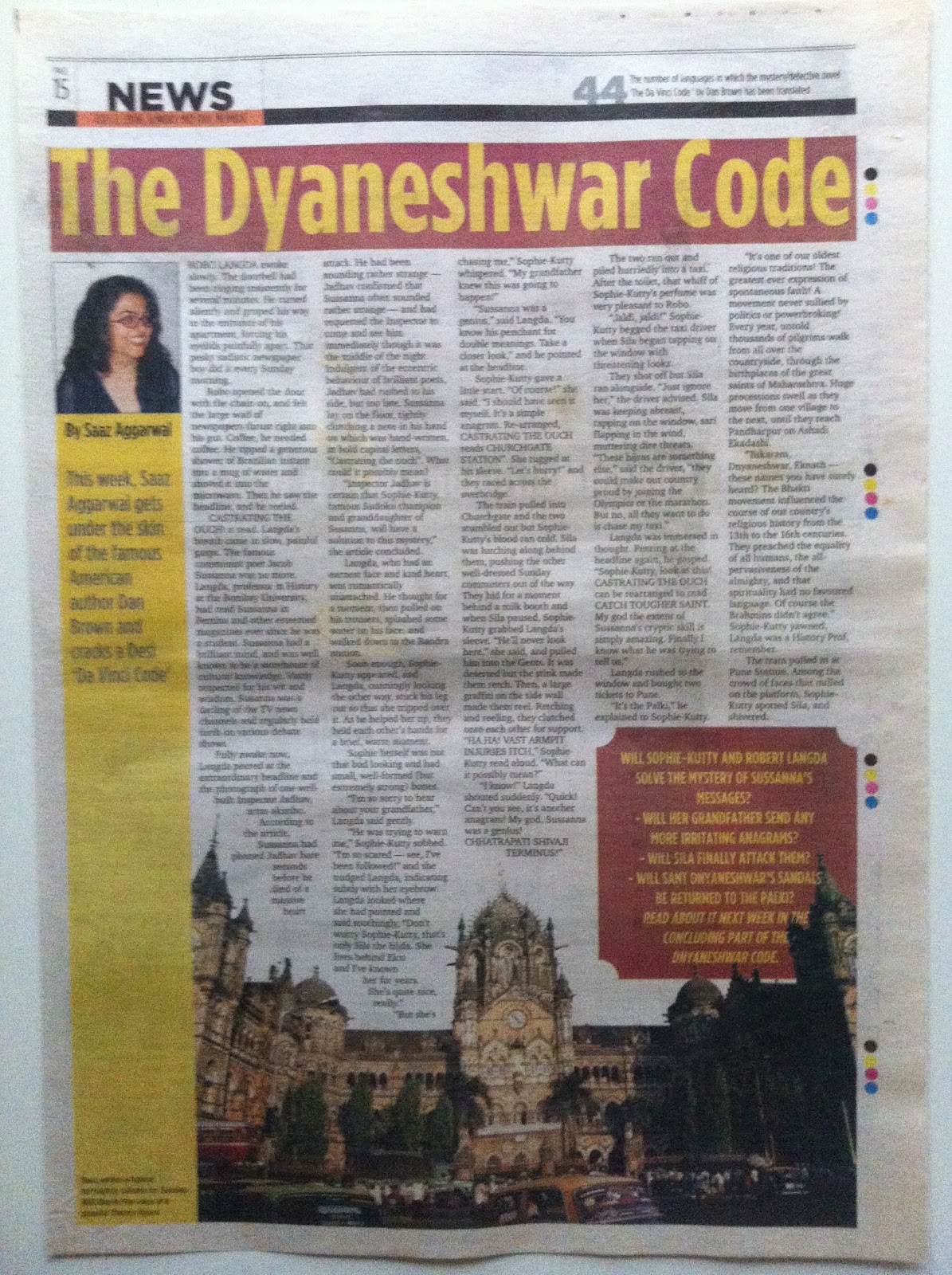
The Dnyaneshwar Code

Robo Langda awoke slowly.
The doorbell had been ringing insistently for several minutes. He cursed silently and groped his way to the entrance of his apartment, forcing his eyelids painfully apart. That pesky sadistic newspaper boy did it every Sunday morning.
Robo opened the door with the chain on, and felt the large wad of newspapers thrust right into his gut. Coffee, he needed coffee. He tipped a generous shower of Brazilian instant into a mug of water and shoved it into the microwave. Then he saw the headline, and he reeled.
CASTRATING THE OUCH! it read. Langda’s breath came in slow, painful gasps. The famous communist poet Jacob Sussanna was no more. Langda, professor in History at the Bombay University, had read Sussanna in Femina and other esteemed magazines ever since he was a student. Sussanna had a brilliant mind, and was well known to be a storehouse of cultural knowledge. Vastly respected for his wit and wisdom, Susanna was a darling of the TV news channels and regularly held forth on various debate shows.
Fully awake now, Langda peered at the extraordinary headline and the photograph of one well-built Inspector Jadhav, arms akimbo. According to the article, Sussanna had phoned Jadhav bare seconds before he died of a massive heart attack. He had been sounding rather strange – Jadhav confirmed that Sussanna often sounded rather strange – and had requested the Inspector to come and see him immediately though it was the middle of the night. Indulgent of the eccentric behaviour of brilliant poets, Jadhav had rushed to his side, but too late. Sussanna lay on the floor, tightly clutching a note in his hand on which was hand-written, in bold capital letters, “Castrating the ouch”. What could it possibly mean?
“Inspector Jadhav is certain that Sophie-Kutty, famous Sudoku champion and granddaughter of Susanna, will have a solution to this mystery,” the article concluded.
Langda, who had an earnest face and kind heart, was romantically unattached. He thought for a moment, then pulled on his trousers, splashed some water on his face, and walked down to the Bandra station.
Soon enough, Sophie-Kutty appeared, and Langda, cunningly looking the other way, stuck his leg out so that she tripped over it. As he helped her up, they held each other’s hands for a brief, warm moment.
Sophie herself was not that bad looking and had small, well-formed (but extremely strong) bones.
“I’m so sorry to hear about your grandfather,” Langda said gently.
“He was trying to warn me,” Sophie-Kutty sobbed. “I’m so scared – see, I’ve been followed!” and she nudged Langda, indicating subtly with her eyebrow. Langda looked where she had pointed and said soothingly, “Don’t worry Sophie-Kutty, that’s only Sila the hijda. She lives behind Elco and I’ve known her for years. She’s quite nice, really.”
“But she’s chasing me,” Sophie-Kutty whispered. “My grandfather knew this was going to happen!”
“Sussanna was a genius,” said Langda. “You know his penchant for double meanings. Take a closer look,” and he pointed at the headline.
Sophie-Kutty gave a little start. “Of course!” she said. “I should have seen it myself. It’s a simple anagram. Re-arranged, CASTRATING THE OUCH reads CHURCHGATE STATION. She tugged at his sleeve. “Let’s hurry!” and they raced across the overbridge.
The train pulled into Churchgate and the two stumbled out but Sophie-Kutty’s blood ran cold. Sila was lurching along behind them, pushing the other well-dressed Sunday commuters out of the way. They hid for a moment behind a milk booth and when Sila paused, Sophie-Kutty grabbed Langda’s sleeve. “He’ll never look here,” she said, and pulled him into the Gents. It was deserted but the stink made them retch. Then, a large graffiti on the side wall made them reel. Retching and reeling, they clutched onto each other for support.  “HA HA! VAST ARMPIT INJURIES ITCH,” Sophie-Kutty read aloud. “What can it possibly mean?”
“I know!” Langda shouted suddenly. “Quick! Can’t you see, it’s another anagram! My god, Sussanna was a genius! CHHATRAPATI SHIVAJI TERMINUS!”
The two ran out and piled hurriedly into a taxi. After the toilet, that whiff of Sophie-Kutty’s perfume was very pleasant to Robo.
“Jaldi, jaldi!” Sophie-Kutty begged the taxi driver when Sila began tapping on the window with threatening looks.
They shot off but Sila ran alongside. “Just ignore her,” the driver advised. Sila was keeping abreast, tapping on the window, sari flapping in the wind, muttering dire threats. “These hijras are something else,” said the driver, “they could make our country proud by joining the Olympics or the marathon. But no, all they want to do is chase my taxi.”
Langda was immersed in thought. Peering at the headline again, he gasped. “Sophie-Kutty, look at this! CASTRATING THE OUCH can be rearranged to read CATCH TOUGHER SAINT. My god the extent of Sussanna’s cryptic skill is simply amazing. Finally I know what he was trying to tell us.”
Langda rushed to the window and bought 2 tickets to Pune.
“It’s the Palki,” he explained to Sophie-Kutty. “It’s one of our oldest religious traditions! The greatest ever expression of spontaneous faith! A movement never sullied by politics or powerbroking! Every year, untold thousands of pilgrims walk from all over the countryside, through the birthplaces of the great saints of Maharashtra. Huge processions swell as they move from one village to the next, until they reach Pandharpur on Ashadi Ekadashi.
“Tukaram, Dnyaneshwar, Eknath – these names you have surely heard? The Bhakti movement influenced the course of our country’s religious history from the 13th to the 16th centuries. They preached the equality of all humans, the all-pervasiveness of the almighty, and that spirituality had no favoured language. Of course the Brahmins didn’t agree.”
Sophie-Kutty yawned, Langda was a History Prof, remember.
The train pulled in at Pune Station. Among the crowd of faces that milled on the platform, Sophie-Kutty spotted Sila, and shivered.
  • Will Sophie-Kutty and Robert Langda solve the mystery of Sussanna’s messages?
  • Will her grandfather send any more irritating anagrams?
  • Will Sila finally attack them?
  • Will Sant Dnyaneshwar’s sandals be returned to the Palki?
Read about it next week in the concluding part of The Dnyaneshwar Code.
The Dnyaneshwar Code, first published by Sunday Mid-day on 2 July 2006, parodies Dan Brown's style of writing and traces the history of a lesser (Indian) Robert Langdon. Part II tomorrow, same time, same place ... 

22 May 2013

80 Questions to Understand India by Murad Ali Baig

Black or white?

Much of what we understand to be history is often just propaganda. In this book, Murad Ali Baig answers basic questions that make us confront our assumptions and see things with more clarity and less bias than before. These questions build up from the earliest history: “Was India one of the oldest civilisations?” and take us through various stages our textbooks define and some the author introduces. There is a lot of solid information here, and presented very simply and without fuss.
Murad Ali Baig draws his information from various sources, at times questioning the bias or standpoint of the source, and offering a more plausible interpretation instead. And some of his questions address widely-accepted theories and may appear provocative:
  • Were the early Indian temples really Hindu?
  • Did Muslim invaders actually desecrate Hindu temples and slaughter Hindus by the thousand?
  • Did the British exploit India’s wealth?
In the course of an answer to a question about whether religion was created by priests and rulers or sages and prophets, he writes:
The message of all the prophets and sages were imbued with joy. But the priests shrewdly understood that hatred was a more powerful uniting factor than love. When people loved together there was always rivalry but that there was always unity when people hated together. Hatred was the core of religious fervour uniting believers against the perceived enemies of every faith. Throughout the world, it was the greed for power and wealth of the rulers instigated by their priests that caused more people to die for religion than from almost any other cause.
Sometimes, and increasingly so in the Indian subcontinent, history is written and taught with a view to controlling people and creating a certain mindset or feelings. This book, on the other hand, presents Indian history in a way that encourages the reader to develop a mature attitude towards both past as well as future.

17 May 2013

Lost in Transmission by Jonathan Harley


A book that came out of a dream job

Jonathan Harley worked as Australian Broadcasting Corporation's New Delhi-based South Asia Correspondent from 1998 to 2002. This is his account of his time here. 
Why did I just read a book that’s more than ten years old? Because it arrived in the post for me one fine day, a present from Sri Aiyar who lives in Adelaide, and who (I think) enjoyed the book and thought I would too. I did. It revived memories of interesting, often horrible, times in our recent past. I enjoyed Jonathan Harley’s perspective and the way he’s able to show the funny side of things without causing offence, perhaps because he so liberally pokes fun at himself too. India, he says, is the richest, poorest, most charming, infuriating, beautiful and hideous land in the history of time. And it can be as efficient as it can be chaotic. It is, in fact, a poor man’s America! 
Jonathan Harley writes of Pakistan’s “blokes-only” political rallies; of the cricket obsession of India and the overwhelmingly emotional, rather comic, response to Don Bradman’s death; of the reaction to 9/11 in Kabul where he happened to be at the time. When he enters Wagah’s no-man’s land, it feels like a stroll between two patriotic theme parks. (And Dosti must be the first bus in Indian history to arrive on time.) There’s more.
Travelling with him from one news-making event to the next, I found Jonathan Harley sensitive to what he observes and experiences. His reports are accurate; his analyses shrewd; the patterns he describes creative and discerning. However, his grasp of history occasionally wavers. This naturally makes some of what he writes appear superficial.
Here are some random bits pulled out from the book which will give you an idea of his overall style and approach.
Soon after arriving in India, Jonathan Harley's first assignment is the horrible Staines murder and he sees Gladys Staines very soon after her husband and children were burnt to death by zealots: “India’s latest widow sits calmly, almost serenely, patiently fielding reporters’ questions. Perhaps she has not had time to cry or she’s waiting for some privacy. She’ll wait forever. Like most things in India, grieving is a public event.”
Covering the massacre of Nepal’s royal family, he observes, “I pass a family offering prayers and lighting incense before portraits of the King and Queen at a makeshift mourning platform. While their rituals of piety and humility verge on the poetic, I can’t help but think Nepal would be better off without its royalty. Monarchies have long struck me as a medieval abomination best left to history."
Portraying Mumbai’s dabbawallas, the dabba Jonathan Harley follows shows us more than just the six-sigma precision of this institution – it exposes the middle-aged office workers of the city who still rely on their aging mummies to cook their meals for them.
Of his foray into Taliban country – ‘No-fun-istan’ – he writes, “First came the Dark Ages. Then came Mad Max. And somewhere between, suspended in time, space and sanity, in a whirlwind of dust and devastation, came the Taliban. I’ve landed in an Islamic utopia with Cold War weaponry."
At Rajasthan’s luxurious Neemrana Fort Palace, he sees not just the “beautiful blend of richly coloured Indian art and Euro-chic simplicity” but, directly below, the crowded village with muddy paths and sickly cows. “It’s here that most of the hotel’s cleaners, porters and labourers live. The realities of India’s luxuries are never far from view.”
Daunted at first by his battalion of domestic and office staff, he’s self-critical enough to describe his situation after a few months thus: “I don’t drive, wash or iron, I don’t even make my morning coffee. And I no longer notice. I have become part of the modern Raj – hopelessly dependent, and resentful when ‘staff’ make mistakes or don’t read your mind.”
‘Pakistan’, Jonathan Harley informs us, is actually an acronym: “It stands for Punjab, Afghania, Kashmir and Indus-Sind, with the suffix ‘-stan’, which means ‘land’. Unfortunately for the people of the restless south-western province of Baluchistan, ‘B’ did not make it into the mix – which may go some way to explaining the Baluchis’ keenness to secede.”
The scene that most endeared Jonathan Harley to me is set in Eden Gardens where one very white Australian face stands out prominently in a sea of Indian fans (and they’re not so much cheering as jeering). India is playing Australia and the rowdy fans are roaring as each Australian wicket falls. Far from cowering, our hero shouts, “C’MON AUSSIE!” inviting attack from the passionate fans around him, safe because apparently Indians have an amazing ability to get overcharged without exploding into violence. And Jonathan Harley declares: “As I watch, boggle-eyed at this outpouring of pride and passion, I see a nation united. For all India’s diversity and division, cricket is the country’s one common religion. Across boundaries of class, caste, religion and language, everyone can pray in the temple of cricket. It is glue, binding a country that seems to teeter on the verge of disintegration, offering a shared purpose, playfulness and identity.”
I did like this book, and intend to hang on to it, despite its wobbly bits, as a history/anthropology resource for the future. 

13 May 2013

Miss Timmins' School for Girls by Nayana Currimbhoy

The Thane of Fife had a wife. Where is she now?

My last blog post was in October. For the 6+ months since then, I was unable to read. After a relentless book-a-week schedule of more than five years, it was disconcerting. For stretches I forgot that there was such a thing as reading. There were also occasions when I tried to pick up a book and found myself unable to get into it. I began to reconcile myself to the possibility that black-and-white fountain was drying up.
One day, I realised that I had actually finished reading a book. It had taken me several months, much longer than a book usually takes. One reason was because it was an unusually long book replete with intricate detail. Another was because I was reading it aloud to my friend Gladys, to whom I read aloud for 2 hours every Tuesday morning, because she can no longer read herself. Both of us enjoyed it very much. Gladys, an intellectual and particularly well read – she was a career librarian – will always boast that she loves a good murder mystery. As we read, she complained that the book was going on and on a bit too much. However, we both agreed that the biggest charm of this book lies in its detail.
Miss Timmins’ School for Girls is in Panchgani and perhaps by a coincidence, or perhaps not, appears very similar to the Kimmins’ High School, a hoary girls’ boarding school in the same town. Although this book is probably not based on a true murder mystery in the real Kimmins’, it certainly paints a very lifelike picture of what things were like there in the 1970s, the period in which this book is set.
Having studied at a boarding school myself around then, I could certainly relate to various fine aspects that emerge in the narration, such as the interactions between students, and between teachers and students; the emotional environment and general value systems; the emphasis on English literature and the general snobbishness of the English speaker; as well as characteristics of life in a small town.
I found this book easy to read and enjoyed it, in particular the many different life realities of that particular time and place that it introduces the reader to. As a murder mystery, the plot is strong and convincing. I found the many meandering diversions and descriptions of the narrative not just interesting, but invaluable as a historical account of the time. However, I don’t think this approach lends itself to a pace that would satisfy someone looking for a thrilling page-turner.

21 January 2013

COVER STORY in DAWN BOOKS SUPPLEMENT: Sindh: Stories from a Vanished Land by Saaz Aggarwal

Reviewed by Sarah Ansari


“There are three ways in which we use memory: through amnesia, nostalgia and selection. The collective memory of a community contains each of these. We use amnesia and nostalgia to give us selective memory”. These insights drawn from the work of Pierre Nora, the French intellectual responsible for pioneering work on the relationship between history and memory, underpin the exploration of collective as well as individual remembering in Sindh: Stories from a Vanished Homeland. On its pages fragments of memory are pieced together by Saaz Aggarwal in a very personal search for the Sindh left behind by Hindus who departed in the years following Partition. Taken as a whole, the stories included here shed fresh light on how their narrators, both men and women, and their families remember the past, and in the process also draw attention to the challenges of resettlement that awaited them across the newly constructed border between India and Pakistan.

Partition-related migration, after all, was a two-way process, and Sindh witnessed both comings and goings on a massive scale in the years after 1947. While Pakistanis today are familiar with the considerable demographic upheaval that drew Muslims from other parts of the subcontinent to the province, the story of the non-Muslims who migrated to India has taken longer to be told. As with their counterparts crossing the border in the other direction, getting used to their new surroundings was far from straightforward, though the support from the wider Sindhi Hindu diaspora could often prove invaluable. Of course, Sindh in reality is not a vanished land — just ask the many millions who live there today — but the kind of place that it once was certainly no longer exists, particularly when viewed from the perspective of its pre-Partition Hindu communities, who, as this study reminds us, enjoyed a distinctive culture sustained for generations by the social, economic and political realities of the lower Indus Valley.

Structured along scrapbook lines, Stories from a Vanished Land interweaves factual information drawn from secondary sources — academic books and articles — with first-hand accounts, photographs, poetry and even cherished family recipes which together evoke a bittersweet nostalgia for times lost and even opportunities missed. While unwelcome reminders of communal politics and the violence associated with Partition occasionally intrude, there is also warm affection and appreciation for the people as well as the place left behind by these migrants. According to many of the testimonies included here, Sindhi Hindus could often be on the receiving end of genuine acts of kindness from local Muslims. One of them, Aruna, later reminisced about her train journey to India in 1947:

“The soldier remained at his post throughout the journey. In the political barter arrangement, one train was exchanged with another at the border town, Kakad. On the opposite platform was a train stuffed full of people, with many perched precariously on the roof, and shouting anti-India slogans with gusto. After the train crossed the border, the soldier got off the train. He brought us food packets which volunteers were distributing, and quietly walked away, not turning once to see us waving goodbye. Looking back, I marvel at the sheer faith my father had in his Muslim student [the soldier in question], entrusting his beautiful daughter and the others of his family to this commando: a reflection of the peace and harmony with which the two communities lived in Sindh, following their own separate faiths as respectful neighbours.”

More than anything, the book targets an Indian readership, many of whom, Aggarwal suggests, are ignorant of Sindh’s distinctive history and traditions, preferring easy stereotypes over complex realities. Hence a desire to put the record straight drives her project: as the dedication states, families like that of Aggarwal “left their homes in Sindh without looking back, crossed a new border and made new lives for themselves in a new country far away from the land of their ancestors without complaining, without asking for anything, building their own fortunes and contributing to those around them in a large number of ways”. To take the example of Aggarwal’s mother, Situ, who in her own words “became a Bombay girl” following her family’s migration to India: “We Sindhis did not suffer the kind of violence and loss of life or extent of trauma that some other Partition-affected communities did.”

On occasion, it must be said, the narrative can read a little naively. There is not, perhaps understandably bearing in mind the author’s approach, a great deal of critical reflection. Sindhi Hindus, for instance, are compared rather simplistically with other diasporic

people — Jews, Tibetans and Palestinians — exiled permanently from their ancestral homelands but under very different circumstances. Examples of individual involvement in organisations such as the RSS are mentioned but not questioned. But in many respects, this is oral history pure and simple, a collection of living people’s testimony about their own experiences, for good or bad. Not before time, historians have come to recognise that the everyday memories of everyday people, not just of the rich and famous, command historical importance, and if we do not collect and preserve those memories, those stories, one day they will disappear forever. So, as with any personal collection of reminiscences such as this, elements of selectivity combined with personal subjectivity are inevitably present. But is this necessarily a bad thing? After all, as one of Aggarwal’s interviewees points out, “one can learn a lot about the Sindhi community by examining what they have forgotten and what memories they nurture. Why have they forgotten some things? Why do they nurture others?” These are important questions which we might all ask ourselves when thinking about our own pasts and how we have come to be where and what we are today.

The reviewer teaches history at the University of London

Sindh: Stories from a Vanished Land

(Memoirs)

By Saaz Aggarwal

Black-and-White Fountain, India

ISBN 978-81-922728-5-6

320pp. Indian Rs400

17 October 2012

Some Hits Some Misses by Prasanta Choudhury

The mind should dominate the ego

I know the author of this book as a person of few but well-chosen words; the same can be said of this book. Prasanta Choudhury retired from corporate life in 2002 as President of Formica India.
Some Hits Some Misses contains anecdotes from his working life and they cover offbeat incidents, personal insights into human relations from a management perspective, a close-up view of the Indian manufacturing industry in its most difficult phase, and others. It was interesting to note Prasanta’s experience of how common sense fares in a hierarchical establishment.
I found the book very well written – charming, in fact – and carrying important messages not just for managers but all who enjoy life and want to live better. What I liked best was the last section, in which Prasanta goes back to work after his retirement and experiences work life outside the glamour of the corporate world – but also learns a set of ‘today’ skills out of the reach of many of his contemporaries. 
One of the things I did not like was the periodic textbook-like discourses on management. I somehow don’t think it is in Prasanta’s nature to preach; for some reason I believe that he thinks (like I do) that the best lessons come upon one when in a relaxed and receptive frame of mind, such as while listening to a story. Prasanta’s stories have their lessons subtly woven into them and I found the commentary superfluous.
When I asked him about this he said that he had been told that early drafts of the book were too autobiographical and that he had rewritten it with the text-bookish material. He also told me that he had removed full chapters which were autobiographical.
I felt really sorry to hear that, as India gears itself to become one of the world’s most productive manufacturing nations, market demands still foster the creation of masses of rote-learning clones. The true managers, of course, will be the ones who will seek out the autobiographical stories. They are the ones who understand their value, because they have the maturity to absorb the wisdom and insights that can be gathered from someone like Prasanta Choudhury.
Even more than its management lessons, this book’s value to me is as a first-person record of the early days of manufacturing in India. To have mentioned the year in which each incident took place would have increased that value and I felt sorry it wasn’t done.

13 October 2012

Circle of Three by Rohit Gore


Happy Birthday Ria, Aryan, Ranasahab
In this book, three interesting characters, each in a difficult situation and very unhappy, find solace in each others’ company. All are privileged and very ‘today’, and all are writers.  Not only that but their horoscope for the week will always be identical, because they share a birthday. However, they cross generational and gender boundaries, and there's also substantial personality diversity. Some of the subsidiary characters were also quite appealing.
I didn’t care for the title but I did find Circle of Three easy to read, with a gripping plot, lifelike characters and relationships, and even a gratifying moral base. Rohit Gore is a good storyteller. This book is well constructed and I found the ending satisfying without being clichéd.
Books like this make me happy. Like most readers, a no-stress and engaging story is my primary reason to read. Second, I particularly appreciate a story which has recognizable characters and situations from our own environment – until quite recently Indians who read in English did not have that.  Can I dare to hope that fans of Chetan Bhagat will branch out and discover Rohit Gore, whose language is as simple but less affected, whose values and perceptions are straighter and more dignified?