
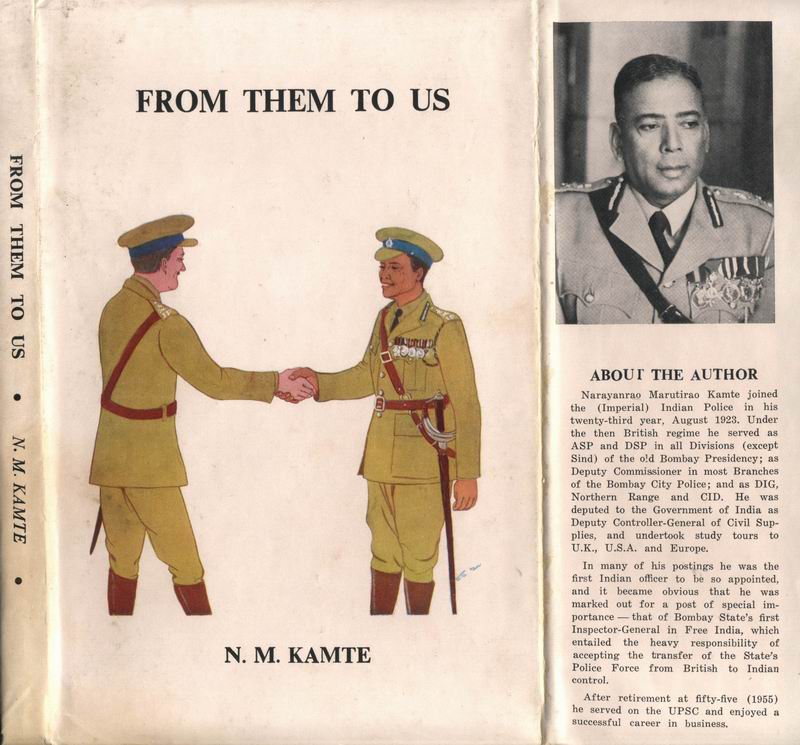
 N.M. Kamte was Bombay (now Maharashtra) State’s first Indian Inspector General of Police, and a few days short of being the first in the country.
His memoirs are written in a wry, humorous style, reflecting the language and values of the time. They show him as fiercely proud, intolerant of nonsense (no matter who it comes from), fearless, of exceptional intellectual and operational ability and keenly conscious of detail.
I found it a fascinating account of life for a policeman during the last 25 years of British rule in India, outlining the very different law-and-order situations of the time as well as the particular emotional dilemma of an Indian working for the British government during the struggle for Independence.
Rather than writing a review of this exceptional book, I am giving here a summary of some of its important points, and reproducing certain particularly fascinating paragraphs which I felt were best told in his own voice.
N.M. Kamte joined the Indian Police in 1923 when he was 23. Under the then British regime he served as ASP and DSP in all Divisions of the old Bombay Presidency (except Sindh); as Deputy Commissioner in most branches of the Bombay City Police, and as DIG, Northern Range and CID. He was deputed to the Government of India as Deputy Controller-General of Civil Supplies, and undertook study tours to the U.K., USA and Europe. After retirement at 55, he enjoyed a successful career in business. Through all this, he continued to uphold not just his personal quest for excellence in all that he did but also family rituals, beliefs and traditions, remaining devoted to Lord Pandurang at Pandharpur. Life for officers like him who were duty-conscious, disciplinarian, hard task-masters and long reared in British service tradition, was grim. Indians working in government faced racial disdain from some but they learnt discipline and even-handedness from others. In spite of the discrimination, they remained loyal and dutiful.
As a student, N.M. Kamte managed to create the record of being confirmed just two and a half months after graduating from the Police Training School and scarcely a year after first reporting on duty though confirmation normally occurred after two years.
Of his days in the PTS he writes: In the early 1920s, the Civil Services in India recruited a number of British ex-Officers who had been demobilized after the recently concluded Great War; these were relatively senior in age. Of those recruited at the normal age, the 1923 batch consisted of four Indians and four Britons.
As in the Indian Civil Service, so in the Indian Police, Indians still formed a small minority, and we could not help feeling ourselves to be to some extent “on trial”; indeed, two or three Indian officers had recently been removed from service, presumably as “unsatisfactory” or “unreliable.” There was moreover a clear discrimination against us as in the matter of the daily P.T.; British ex-Army trainees were automatically exempted from this whereas I, who had acquired considerable experience of P.T. during my military training, to say nothing of the Honorary Commission I had held in the Indian Territorial Force, was refused exemption.
Our day at the P.T.S. began at 6.30 with a three-mile run, followed by a course of hurdles, and then some strenuous P.T. The physical strain tired some of my colleagues so much that they could not even keep step while marching. For my part, I was determined to go through to the end without a murmur; I was ready to fall dead on the parade ground rather than utter a complaint. The policy, obviously, was to toughen us; and I approved of it.
He then writes of his reputation as a bit of a prig who had come from College with some high-flown ideas of “temperance,” and how he changed his ways: Tuesday were Guest Nights, when the cost of drinks was shared by all equally, and the proceedings used to be further enlivened by boxing bouts. Some of my colleagues felt that I, who had no experience of the manly art, should be taught to box. The result was that at the Wednesday morning parades of swollen noses and black eyes before the Civil Surgeon, no nose was more swollen, nor eye more black, than mine. This sort of thing, I decided, must be stopped. And at last I hit on a plan for stopping it.
“Since you’ve been so kind as to teach me boxing,” I told my instructor on the next Guest Night, “I would like to repay it by teaching you our Indian wrestling.” I was not adept at this sport, but I knew something of it, and felt confident of being able to teach my “persecutors” a lesson in more ways than one. I picked on Bert Caffin for a start, and he agreed to wrestle with me. The chap knew nothing about the game, and I quickly threw him and sat on him, whereupon I began to hammer him fairly hard. Bert’s fellow Britons started to object to this, but I told them not to interfere. “This is the only way to learn wrestling,” I assured them. “Nobody interfered when you were teaching me boxing so painfully, so now you just keep away.” My scheme worked, and from that time there were no more boxing lessons for me. Any strain that might have crept into our mutual relations was relaxed when I began to take drinks with the others.
Working in the Bombay Presidency required skill in many languages. On graduating from the academy, Kamte was posted to Kaira in Gujarat. He says: I went to Ahmedabad without having passed the Gujarati Language examination, but I quickly learned to speak and follow Gujarati well as a result of attending dramas at night with Mr. Dhirubhai Desai, Deputy Superintendent of Police, who used to tell me the meaning of any word in the drama that I couldn’t understand. While attending these dramas, it was quite natural for me also to do night rounds, and this recommended me to my Superintendent as a keen and energetic young officer. The ability to interrogate suspects and witnesses in their own tongue greatly helped me in my investigations.
Along with native languages, it was also important to be well versed in all that the British understood by the expression “etiquette”!
The District Superintendent at Kaira was Mr. W.L. K. Herapath, a fine gentleman and a bachelor, whose sister kept house for him. He at once took me to the Ahmedabad Gymkhana, introduced me to the members present, and proposed my name for membership.
Miss Herapath was very kind to my wife, initiated her into all the mysteries of social etiquette (British style) and taught her all that a Service wife was supposed to know. (This included, of course, the oft-ridiculed little “Not at Home” box for receiving calling cards, which was put up at the outer gate). As a newly-married couple, my wife and I were expected to receive calls from those already in residence at the Station, after which we should return them.
In Ahmedabad Kamte also learned what it meant to belong to a Covenanted Service: I happened to write a Personal letter to the Inspector-General of Police, Sir Francis Griffith, whom I had known since before my father’s death. I received a reply, but Sir Francis evidently wrote separately to my DSP, because Mr. Herapath sent for me and asked me whether I had written to the IG. When I said Yes, he asked how I had begun and ended the letter. I told him, “Dear Sir” and “Yours obediently”.
Then the lecture began. “Look here, Kamte, I’ve received a letter from the IG saying that I’m not training my young ASP. Just remember you belong to one of the Secretary of State’s Services, and when you write to any other officer of those Services, you start “Dear Mr.-“ or if he’s a Knight, “Dear Sir-“ using his Christian name. And you end with “Yours sincerely” or at the most “Yours faithfully.” Understand?”
On another occasion Kamte was reprimanded, You seem to have forgotten that you belong to a great Service in which we are all socially equal!
Rural crime in the 1920s meant fighting gangs of dacoits. Some of these were tribes classified as criminal, and every boy who reached the age of eighteen was required to report to the police for daily “hajeri“ at 10 p.m. The man could not leave the village at night without the Police Patel’s written permission. Kamte writes of the reforms he observed by the SP Ziauddin Ahmed who succeeded an Irish SP, to correct this highly unfair and discriminatory practice.
Transferred to Sholapur District as ASP in charge of the Pandharpur sub-division in 1927, he found himself in a hotbed of potential labour and communal trouble, with a large population of the minority community, a railway headquarters and four big cotton mills. Moreover, the District bordered, and was partly surrounded by, the dominions of HED the Nizam of Hyderabad.
Able to worship at the shrine of Lord Vithoba unlike the other police officers, who were British, he was soon able to break the nexus of greedy priests who kept the local police force happy with their “hapta” and had been extorting money from the poor pilgrim for years.
Faced with an extremely dangerous criminal who had been captured and escaped and tracked down after much effort and stealth, his instructions were, “Shoot to kill; and afterwards plead Self Defence.” As soon as my party came face to face with Tatya Padalkar, they faithfully carried out my orders. Thus ended the career of a notorious dacoit who had spread violence, robbery, death and the fear of death all around him, wherever he went.
His next posting was as officiating SP, Sattara – with immediate effect. He wasn’t even given time to go home and pack. An uncle, following with his luggage, committed a traffic offence: Just inside the city limits, he halted the lorry opposite a restaurant and went in to take refreshments. This was on a busy thoroughfare, where parking was not allowed. The constable on traffic duty, unaware of whose luggage was involved, objected to the lorry’s presence. His questioning annoyed my uncle, who refused to answer, pushed the man in uniform aside, and drove on to my bungalow. The constable reported the affair at the Head-quarter Police Station, and an offence was registered.
When the ownership of the lorry’s contents was discovered, the Police came to me and apologized, assuring me that no further action would be taken. But to their surprise I refused the offer. “My uncle has committed an offence,” I said, “and you must prosecute him.” Much put out by my decision, my uncle requested me to drop the case, but without success. On returning to Poona, he persuaded his sister, my mother, to write to me and make me change my mind. In reply to her letter I explained my position. “As DSP I must not show any partiality or discrimination between one offender and another; however, do not worry about Mamaji, because it is not a serious case.” My uncle was accordingly prosecuted and sentenced to a fine of Rs. 25 (which I paid from my own pocket). This incident enhanced my prestige among my Police force, who now realized that I was a strict officer and would spare no offender, whoever he might be.
Another interesting incident occurred in Mahableshwar, where Kamte was put in charge of the traffic arrangements during the busy Summer Season.
Going for a walk one day, I met a car being driven considerably faster than was permitted. I stopped it and told the driver – a European – that he was going to fast. “Do you know who I am?” he asked me in some irritation. “I am Mr. Green, Secretary to Government, PWD.”
“Do you know who I am? I replied. “I am the DSP, Sattara. And I must warn you not to drive fast again; otherwise action will be taken against you for a traffic offence, and you may even lose your license for driving in Mahableshwar.” Highly annoyed at my “interference”, he drove away.
Appreciating that I had clashed with a very senior official, I sent him a polite personal letter about the incident. His response was, “Looking to our relative positions, your letter is rude and not in order.” Again I wrote, referring him to the Motor Vehicle Act and Rules, which, I pointed out, contained no mention of “relative positions”, and warned him that in case of a repetition of his offence, his license would be cancelled. Mr Green then wrote to my IG complaining of the whole affair; but nothing came of it.
Ego clashes with British officers were not uncommon, but being always uniformly correct and polite, Kamte was able to preserve the law and his own dignity. During the Summer Season mentioned above, he was even able to convert a white Police Sergeant who refrained from saluting him, the DSP, until he saluted not only me but my Deputy as well; moreover, he now stood to attention, as he had never done previously, before my Sub-Inspector Rao Saheb B.L. Khedkar, who was officially his senior.
In 1929, Kamte was posted to Belgaum, a hot-bed of crime. Murders and dacoities were everyday occurrences.
One such crime that I investigated originated in Bail-hongal, a village in which certain powerful persons competed with each other in the number of women they kept. For a woman to exchange one man’s protection for another’s, would set off a bloody fight which might even end in murder. In the case I followed up here, one of the kept women had died, and as her body was being burned, one man threw his rival on to the blazing pyre, so that he was burned alive.
With the launch of the Quit India movement in 1930, a new and particularly poignant struggle began: At this point, I would like to pause and invite the reader to reflect for a moment on the extremely difficult and embarrassing position in which Indian employees of a colonial government, from Ministers to humble orderlies and constables, found themselves in those days. Their natural patriotism as Indians, often aggravated by examples of white-skinned arrogance, was inevitably at war with their age-old traditions of loyalty to the authority which recruited and paid them, as well as with their sincere admiration for British efficiency and their realization of the many benefits accruing to India from the Pax Britannica. For a few individuals, patriotism proved too strong to be resisted; but by far the greater number of Indians who served the British Crown remained “true to their salt”, while at the same time exercising more gentleness, patience, tact and understanding than all save a few Britons would have shown in their place. It was men of this sort, who could honourably, faithfully and humanely reconcile their divided loyalties, who proved themselves the most reliable instruments in the hand of an India which at last achieved Independence.
On 4 May 1929, the Viceroy (“in his wisdom”) arrested Mahatma Gandhi, and within forty-eight hours the whole of India was aflame.
On 6 May, Kamte had been at Pandharpur dealing with the case of an old woman shopkeeper near the big temple who had obstinately refused to close her shop during a hartal which others had observed. A resentful crowd had looted her shop and run off. Visiting the place, Kamte had sent for the local Congress workers and asked them, “You fools! Is this what Mahatma Gandhi teaches you – to rob an innocent old woman?” They returned the amount the woman had lost and the matter was settled amicably. Meanwhile, riots had broken out in Sholapur. Two policemen were burned to death. Arriving back, he was astonished to find a white-capped Congressman directing the traffic! If that wasn’t enough, a “white-cap” was sitting in his chair, another in the DSP’s chair and one even holding a police rifle and guarding the Treasury.
Controlling this situation took enormous courage, and Kamte describes how he talked reasonably to the Congress leaders, defused inflammatory situations and brought the situation back to normalcy.
Hectic days followed. The eyes of all India were on our Sholapur. Cipher telegrams (whose purport was often known in the bazaar before they were laboriously deciphered by me) arrived for the DSP from all quarters, from the Viceroy downwards, and all these I acknowledged, answered or acted upon on my superior’s behalf.
Various stressful events took place, but Kamte’s ever-present sense of humour has him describe some amusing ones too: Another time, the military court prosecuted a man for “resisting and evading arrest.” I tried to explain to the President of the court that such a charge was faulty, since it was not possible for a man at the same time to “resist” and also “evade” arrest. The point was perhaps too subtle for the gallant Judge at first, and he showed his displeasure at my venturing to correct him. Later, however, he must have understood my criticism for he quietly reduced the charge to simply “evading arrest.”
Now taking charge of the Panch Mahals District during the Civil Disobedience Movement, Kamte often had to trace Congress “workers” whom the Government wished to arrest but had gone “underground”. Warrants would be “served” and if the person did not surrender within the stipulated period, the court was entitled to confiscate his property. One who they were trying vainly to trace was a certain Wamanrao Mukadam, but Kamte received a personal request from Col. Parab, who was Khazgi Karbhari to H.H. the Maharaja of Baroda, and a personal acquaintance, that Mr. Mukadam’s property should not be confiscated. Kamte promptly suggested that Mr. Mukadam should meet him to discuss the matter – and he did. Kamte promptly requested Mukadam not to create any trouble. Mukadam promised to honour the request and was even able to give him some assistance in a particularly interesting incident, a small indication of how little the press has changed from that day to this:
There came a day when Miss Hamida Tyabji, granddaughter of the grand old Mr. Badrudding Tyabji, announced in the Press that she intended to address a public meeting in one of the principal squares of Godhra (the Headquarter town of our District). I at once requested Mr. Mukadam confidentially to do me the favour of arranging that nobody should turn up at the announced meeting.
When Miss Tyabji arrived at the time fixed, she saw scarcely a soul there except me and my force of Police. Greatly surprised, she waited for half an hour, after which I approached her and suggested that since the planned meeting had fallen flat, she might as well return to Baroda whence she had come. She said she would not go, and asked to be arrested. I replied that I would escort her from the spot, which she might consider, if she liked, as equivalent to an arrest. “Oh, but you must handcuff me,” she insisted, but I said this would not be necessary and that I would see that she did not escape.
I took her to my bungalow and ordered tea for both of us. She showed considerable annoyance and vowed that she would not drink tea with me. So I assured her that it was not “Government” tea, but came from my own private store. “Surely,” I urged, “you won’t object to accepting my personal hospitality?” Then she consented to drink the tea.
“I’m sure Col Parab must have spoken to you about me,” she accused, “and that is why you are not arresting me. Will you deny it?”
“The Colonel has not spoken to me about you,” I answered, “and the reason why I have not arrested you is that you did not deliver a speech, and there was nothing we could prosecute you for.” In the evening I sent her back in the care of an old Muslim Sub-Inspector in plain clothes, who conducted her safely to Baroda and left her at her home.
Next morning’s local papers – soon to be copied by the Press of other parts of the Presidency – carried banner headlines describing how Miss Tyabji had been arrested and her audience forcibly dispersed by means of a lathi charge!
Dealing with royalty required another dimension of management:
On the occasion of one Viceregal visit to Baroda, I was present in uniform at the Railway Station along with the Maharaja, waiting for HE’s special train. HH enquired whether his guest would be wearing top hat and full ceremonial dress, only to learn that the Viceroy planned to detrain wearing an ordinary lounge suit. Sayaji Rao, who was more jealous of his due dignity and respect than were most of his brother Princes, then declared that he would exchange his ceremonial robes for ordinary clothes, and that although the Guard of Honour would still attend, the Baroda flag would not be lowered as the Viceroy alighted from his carriage. Intimation to this effect was hastily sent to HE’s staff, while his train still waited at the Outer Signal, and he then agreed to put on his ceremonial dress instead of a plain lounge suit.
Still at Panch Mahals, Kamte writes of another event in 1936 – where once again the villainous press has a role to play!
Communal riots broke out in Bombay (later, in Poona also) during the hot months, when brittle tempers are apt to reach breaking point. Bombay is only a few miles distant from my headquarter town of Thana. While passing a mosque, a Hindu procession had played loud music, which had angered the Muslims. Fighting ensured, causing casualties whose figures were published daily in the Times of India and other papers. The publication of these figures had the effect of touching off a fiendish rivalry, with each community determined to kill a larger number of “the others” than had been killed from its own members. The favourite weapons were, as usual, knives and daggers, and many of the victims were women, children, elderly men, and other such helpless persons whose only “crime” was that they belonged to the “wrong” community.
I was astounded at the way in which the Bombay Police allowed these provocative figures of dead and mutilated to be publicized, as well as at the inexplicable delay which was allowed to occur in taking preventive measures such as enforcing curfew or banning the carrying of deadly weapons. Such measures were taken, I noted, only after the carnage had raged for three or four days, by which time all sanity had vanished and the situation had gone completely out of hand. I vowed that if ever I should find myself responsible for keeping the peace in Bombay, I would nip the trouble in the very bud and save the lives of countless innocent citizens.
In April 1938, Kamte was sent to the UK to attend a short course at Scotland Yard in London but finding it too short to be of much practical use, applied for leave to stay on and learn more about the working of the Metropolitan Police.
In September he came back to India and was posted as DCP Motor Vehicles Department in Bombay, responsible for all the traffic control of the city.
In 1939, the first Congress Ministry had introduced prohibition in Bombay Province under the Bombay Akbari Act and in early 1940, Kamte was appointed DCP Prohibition. When he told the Commissioner WRG Smith, “Sir, I have no wish to be in charge of this business. I like my daily drink, and I don’t believe in Prohibition,” Smith replied patiently, “Look, Kamte, I know that Prohibition will not succeed. But one British officer has already failed at it, and if I appoint another British officer, Government will say that we Britons have no interest in enforcing Prohibition and are making it fail on purpose. So you please take charge of this Department. Even if – or when – you fail, Government will at least know that it was an Indian who failed. Government has a very high opinion of you, and won’t blame you, whatever happens.”
The race divide led to interesting situations, and Indian officers found many ways to deal with it. It often made them extra-sensitive, on occasion unnecessarily so, as in the situation Kamte describes here. At the end of May 1941 I was made DCP Divisions, and presently DCP Headquarters. In the latter capacity I served as a virtual Personal Assistant to the Commissioner, and was considered as the senior Deputy Commissioner. Mr W.R.G. Smith would ask me to bring him papers from the steel Confidential cupboard, which contained highly confidential and secret matters such as codes and records of senior officers.
At first this caused me some resentment, from a sense of being treated as a kind of clerk, but I put up with it. And the day arrived when I understood that my superior must have been purposely familiarizing me with all the confidential records and preparing me for the Commissionership. This I realized after becoming Inspector-General in my turn, when I read his note in my own confidential file: “He is doing well and perhaps may be tried as the first Indian Commissioner of Police.”
Next Kamte was posted to Dharwar as DSP and this meant that
I should now have to make a serious study of the local language, Kannada, which I had just begun to learn at Belgaum thirteen years earlier. I applied myself to such good effect that one day, when a subordinate of mine annoyed me, I was able to give him indecent abuse in Kannada. With his face registering as much surprise as repentance, the man exclaimed admiringly, “Sir! Now you’re really one of us!”
In Dharwar, Kamte soon had the opportunity to show his intention and ability of maintaining law and order without resorting to violence. In the case of a well-known freedom fighter who was evading arrest, he was able to trace him to Bombay (through letters written to his wife) and there have him arrested. But, bringing him back to Dharwar, he cleverly arranged for him to be taken off the train at a small flag stop a few miles outside the town and detained in utmost secrecy at the nearby Police Headquarters. He also handled the imminent riot at the town police station with bravery and tact. Trucks had been kept on standby to take the injured to the Civil Hopsital where doctors and nurses were standing by – but were not needed because no shot was fired and there was not a single casualty.
As the law situation got out of hand, Kamte decided to impose curfew on the area, much against the advice of the Collector, finally convincing him that he had to only pass the order and it would be Kamte’s responsibility to actually enforce it.
The way I had in mind for enforcing the curfew was this. I sent out very many small parties of armed men all over the taluka, by night. Each party would fire a few shots in the air, after which some of them would howl and scream in the dark, “Oh God! The Police have shot us! ‘We’re dying!” and so on. Vivid accounts of these “brutal Police firings” used to appear in the Samyukta Karnataka and other newspapers of the region, with the result that people were terrified of venturing out of doors during the prohibited hours.
Now these curfew orders had been passed when the Home Inspector was investigating a dacoity in Alnavar and he was unaware of the situation. On his way home one night, he was surprised to be confronted with a red light. Assuming this meant either dacoits or Congressmen, he continued without stopping, only to hear the crack of a rifle and feel the smack of a bullet striking his car. The situation was later explained and sorted out, but some time later the Collector turned down a dinner invitation to Kamte’s house, saying he did not care to leave his house after sunset and when pressed, said, “No, thank you, Kamte. If your men are capable of firing at their own Home Inspector, they will certainly fire at me!”
Another amusing incident was in the case of the district governor who had complained that, wherever he went, he saw nobody but policemen about – no members of the public – and he had thought it a pity that the Police did not allow the common people to come out and show themselves to the Governor.
I therefore made arrangements so that wherever H.E. went in Dharwar District, no policemen in uniform should be seen, while all such policemen as security demanded should be in plain clothes and squat by the roadside like ordinary villagers. During a rehearsal which we held beforehand, one or two of these “ordinary villagers” aroused my fury by jumping up and springing to attention as soon as I drew near. However, all went well on “the day”, and at the end of his tour the Governor congratulated me on my “very satisfactory arrangements.” Wherever he went, he said, the common people had been allowed to see him and be seen by him, without a single uniformed policeman anywhere.
Kamte continues:
The affection with which the public of Dharwar honoured me was exemplified in 1976, more than thirty years after I had left the District. I hope I may be forgiven for recalling the incident here.
I happened to have gone to Puttuparthy to attend some “miracle” performed by Bhagwan Sathya Sai Baba, and together with a friend of mine I was sitting next to a gentleman who was a Pleader from Dharwar. My friend asked this gentleman whether he remembered “Mr Kamte, a Police officer.” “Who in Dharwar does not remember Mr. Kamte?” was the response. “He was a most popular officer, and during the Quit India Movement he never harassed our citizens. Even a child knows his name.”
“Is that so?” asked my friend. “Well, you can meet Mr. Kamte again – right here!” The Pleader quickly rose to his feet, shook hands with me warmly, and apologized for this failure to recognize me on account of the great change which age had wrought in my appearance. He assured me that the public of Dharwar still cherished my memory as that of an “ideal” Police officer!
In January 1945, Kamte was posted to Bombay as Deputy Controller-General. Here his principal efforts were directed against black-marketeers, a breed which The Great War (as The Second World War was then called) had encouraged to an extent never known before.
One week before Independence was finally granted to India, Kamte “had the crowning honour of being appointed as Bombay’s first Indian IGP.”
The years 1948-49 saw the smooth accomplishment of the tremendous task of merging half a thousand Princely States, of all sizes, with Independent India. One off-shoot of this was the far from inconsiderable job of reorganizing the Police force in all Districts affected by the merger, and of integrating the old State Police personnel with our own.
In October 1949, Kamte was sent on deputation to the USA and Europe to study the Prohibition experiments there. In the USA he was told by the head of the Narcotics Bureau that “you can say that Prohibition in America has been a total failure” and that the crime rate had gone up in the states which had Prohibition. In Holland he was intrigued to find that Prohibition applied only to those who neglected to order some eatables with their drinks; liquor was readily available provided you took something to eat along with it.
Submitting his report to Morarji Desai, Chief Minister of the state and strong proponent of Prohibition, he was faced with an angry reaction,
“Was it for this, that we spent all those thousands of rupees on your foreign tour? You are reporting that Prohibition won’t succeed, just because you like whiskey yourself!” “If you knew that I like whiskey, Sir,” I replied, “why did you send me on this deputation? In any case, I cannot possibly give you a false and dishonest report.”
Kamte’s biography tells many stories of his encounters with the Indian politicians of the time. Despite the Prohibition disagreement, he was apparently a great favourite of Morarji Desai.
On one occasion in the mid-1930s, he was responsible (at the behest of Sardar Patel) for retrieving the love letters of a young Gujarati girl who was being blackmailed.
Soon after Independence, Patel, the newly elected Home Minister visited Bombay and Kamte decided to pay him a courtesy call.
Going to his residence, I sought out his Secretary, Mr. V. Shankar ICS and enquired if I might see the Sardar. “Have you got an appointment with him?” I was asked. “No?” Then how can you see him? I am afraid it can’t be done.”
At that moment the great man’s daughter, Miss Maniben Patel, came into the room and asked what I had come for. On my telling her, she left the room. Returning a minute later, she said – to Mr. Shankar’s amazement – that the Sardar would see me at once.
When I entered his room, he was taking his morning tea, somewhat in the style of the old Moghal breakfast. Before him was a large thali containing milk mixed with saffron, besides halwa, almonds, pistachio nuts and other delicacies. He invited me to drink a cup of his saffron milk, but I declined, saying, “Thank you very much, Sir, but I have just taken my tea and don’t want anything now.”
“I see,” he growled with irritation, “You want toast and eggs like the British officers, I suppose?” To pacify him I accepted a cup of milk and a sweet or two, and after a brief conversation, I took my leave.
Another interesting event occurred in 1950 when the Congress Session was held at Nasik, in an open plot opposite the Railway Police Lines. The Prime Minister was known to be allergic to the close proximity of policemen, even of those whose presence was considered necessary for his protection. I therefore put all my security men into plain clothes; they occupied the first three rows in the pandal, but could not be identified as policemen.
Mr. Morarji Desai asked me to invite Pandit Nehru to dine at the Police Mess. I called on the Prime Minister and said that we should feel honoured if he would visit our Mess and give us the pleasure of his company for dinner. The reply I received – “I have not come here for dinners” – was as rude as it was curt. I saluted without a word and departed.
 The Home Minister, however, was keen for the Prime Minister to attend a Mess dinner and convinced him to do so, informing Kamte that the PM would visit the Training School at 9 pm, address the cadets and then have dinner. Kamte objected, saying that 9 pm was the time for Lights Out, after which no cadet could move outside or keep a light burning in his room and it would not be possible for any cadet to attend any address held after 9 pm.
 Eventually, the PM did arrive at the PTS at a reasonable hour, an address was held, dinner enjoyed, a good joke made by Kamte at the PM’s expense – and a photograph taken “which shows Pandit Nehru laughing and Morarji Desai nervously wondering what on earth would happen”.
In 1951 when Pandit Nehru visited Ahmedabad, a huge crowd had assembled and Kamte instructed the DSP to throw a police cordon around the PM’s immediate vicinity. Nehru angrily demanded that the cordon be removed. Kamte refused. Then Morarji Desai ordered him, as Home Minister and his superior, to do so, at which he did.
The crowd surged forward, threatening literally to submerge Mr. Nehru in the exuberance of their affection.
In his habitual fashion, the PM charged back at the crowd, punching, slapping, kicking, and shouting furiously at them for their utter lack of discipline. All I could do was to keep close behind him and do whatever was possible to shield him from his adorers. Unknown to me, our Chief Minister and Home Minister themselves took shelter close behind me; and as I wielded my cane baton upon those pressing too closely on Mr. Nehru, it was inevitable that I should occasionally strike them also. (Afterwards, Mr. Kher humorously accused me of having “beaten him up”, and showed the marks of my baton on his body.) In the general scrimmage, both Ministers had their shirts torn and lost their caps and chappals – for which, of course I had to offer my apologies.
That evening, Mr Desai wanted me to call upon Pandit Nehru in his special train that was waiting to convey him to his next stop, and converse with him for a few minutes. As a result of the day’s unfortunate incident, I was extremely reluctant to do this, but my Minister insisted, and I had to go. And now our PM showed his true greatness of heart. “Kamte,” he said at once, “I’m sorry for making a fool of myself, getting your cordon removed. Will you have a glass of sherry with me?”
At my polite refusal, he went on, “Oh, I forgot, you belong to a Puritan State! But see, I order you to have a drink, this time!” Then I put down a couple of quick sherries and returned to Mr. Desai to report what had happened between Mr. Nehru and me. On learning that his IGP had accepted an alcoholic drink, even though offered by the Prime Minster, our austere Home Minister was “not amused.”
The book also mentions Kamte’s contributions in various areas such as recruiting women officers to the force, setting up battalions of a Special Reserve Police, new traffic regulations in Bombay, Silent Zone and various Welfare schemes, and initiating a system of tatkas or Information Boards which gave an immediate indication of the current position regarding all serious crime in the State – murder, dacoity, house-breaking and so on.
He also describes a fascinating personal interview he had with Nathuram Godse during which he obtained information from him using gentle tact rather than crude violence. One of the things Nathuram Godse told Kamte in that interview was, “Gandhiji was a great man, one of the greatest this world has ever seen. But he began to sympathize too much with Pakistan, who was our enemy. The last straw was when Gandhiji went on a fast to compel the Government of India to release fifty-five crores of rupees to Pakistan. Then I decided that Gandhiji must be done away with, whatever the cost.”
When Kamte asked him, “What if your own father had done what Gandhiji did?” Godse replied, “I would have murdered him without hesitation.”
After retirement, N.M. Kamte went into business and did exceedingly well. His first initiative was a unit producing containers for pharmaceutical products. Bharat Containers prospered, but Kamte did not enjoy running it, and he sold it for Rs. 75,000 – an enormous sum of money for the time. “Needless to add, those who had once disapproved of my starting the venture, were now no less critical of my relinquishing it!”
One of his greatest pleasures was golf, and during his career he won many trophies. After retirement he also served on the UPSC Selection Board. People were puzzled at the frequency with which the Chairman called me for work, but the explanation was quite simple. Wherever the Board went – Poona, Nagpur, Bangalore, Calcutta, Hyderabad – it just happened that there was a golf-course, to which Mr. Hejmadi and I devoted some careful attention every morning!
After running another business concern briefly before handing it over to other members of the family, he then set up the Expert Services Bureau which offered Security services to Industry and Private Detective services to the Public. Unlike the earlier ventures, this was something for which his previous life and training had prepared him well and the company continues to run with great success, having been inherited by his son Col Marutirao Kamte after retirement from the Indian Army, and which would have been inherited in turn by the valiant Ashok Kamte, his grandson, if he had not been shot down and killed during the terror attacks on Bombay on 26 November 2008.


