In today’s ArchaeoTalks, Lajwanti Shahani talks to Saaz Aggarwal who has recently released her book on the Sindhi community with more curated human stories of the Partition of India in 1947.
This is a story about lost homeland, reinvented lives… eventually loss of language and culture… It also begs the question of a generational trauma. A story which the newer generations of Sindhis are now beginning to engage in.
Saaz talks about her latest book titled Losing Home, Finding Home as well as her experience with the Sindhi people she has interviewed over the years. You can check out this one and all her previous books at Amazon on the link given below.
https://www.amazon.in/Books-Saaz-Aggarwal/...
Thank you, viewers, for joining us today. Please like, share and subscribe to our channel, and don’t forget to hit that bell icon. Also, you can support our work by sponsoring a video or through paid promotions. Please contact us by email on ind.hist.arch@gmail.com
Namaste!

28 November 2022
23 November 2022
Review of Losing Home Finding Home by Kalyani Sardesai in Pune Mirror
Facing loss, finding ground
It’s funny how our parents remain inside us long after they are gone! observes Saaz.

Little wonder then that the narrative of Losing Home, Finding Home, Saaz’s latest work on the Sindhi community amongst others she has written on the Sindhis, is narrated in the voice of her late mother Situ Savur (herself a Sindhi.) It is also a fitting chronicle of a hard-working community that has embraced Pune after losing its home state to partition.
I’m glad I surrendered to her frequent reminders and comments and let her tell the story as many things emerged which may not have otherwise occurred to me to include, she says.
For those who came in late, Saaz Aggarwal has written several books, including quite a few about the Sindhi community. While some of them have documented the community through the stories of individuals and families she has interviewed, some of her work has also been very personal, with insights into what happened to the Sindhi community through the experiences of her mother’s family. For this book, she selected stories that would give an overview of not just Partition but also the very interesting and little-known recent history of the community and how it played a role in the rehabilitation after Partition.
https://punemirror.com/pune-mirror-explore/facing-loss-finding-ground/ Nov 22, 2022


20 November 2022
Review of Losing Home Finding Home by Shreya Jachak in Sunday Mid-day
A new illustrated book by Saaz Aggarwal traces the stories of Sindhi refugees in India
Uprooted from their roots in Pakistan during the
Partition of 1947, the Sindhi community that built life from scratch in India
are celebrated in a new illustrated book by one of their own

Khushiram Kundnani
It must have been an arduous journey for educationist
Khushiram Kundnani, then principal and professor at Government College
University, Hyderabad (Sindh), to traverse through the blood-smeared terrain of
India-Pakistan during the Partition of 1947. More so, because Kundnani did not
travel alone. He carried his college with him to the shores of Mumbai. Bags of
library books and laboratory equipment as companions, Kundnani sought refuge in
a cramped accommodation. He walked the streets of Mumbai looking for a place to
reestablish his college. Every week he wrote postcards to his former
colleagues, cheering them up, promising them that it was just a matter of time
before they would get their jobs and their students back. In just another two
years, the refugee had fulfilled past promises and established the RD National
College in Bandra in 1949.
And this was not the only institution that Kundnani and
other Sindhi refugees established in Mumbai. Now, a just-released book by
author Saaz Aggarwal traces the many stories of Sindhi refugees in the backdrop
of the Partition, what they lost but more of what they found on Indian shores.
Losing Home, Finding Home, is a labour of a decade-long body of research that
Aggarwal conducted around the Sindhi community. A book accompanied with
illustrations by Subhodeep Mukherjee, it brings back true stories, but not
those of trauma but of shared experiences and perseverance.
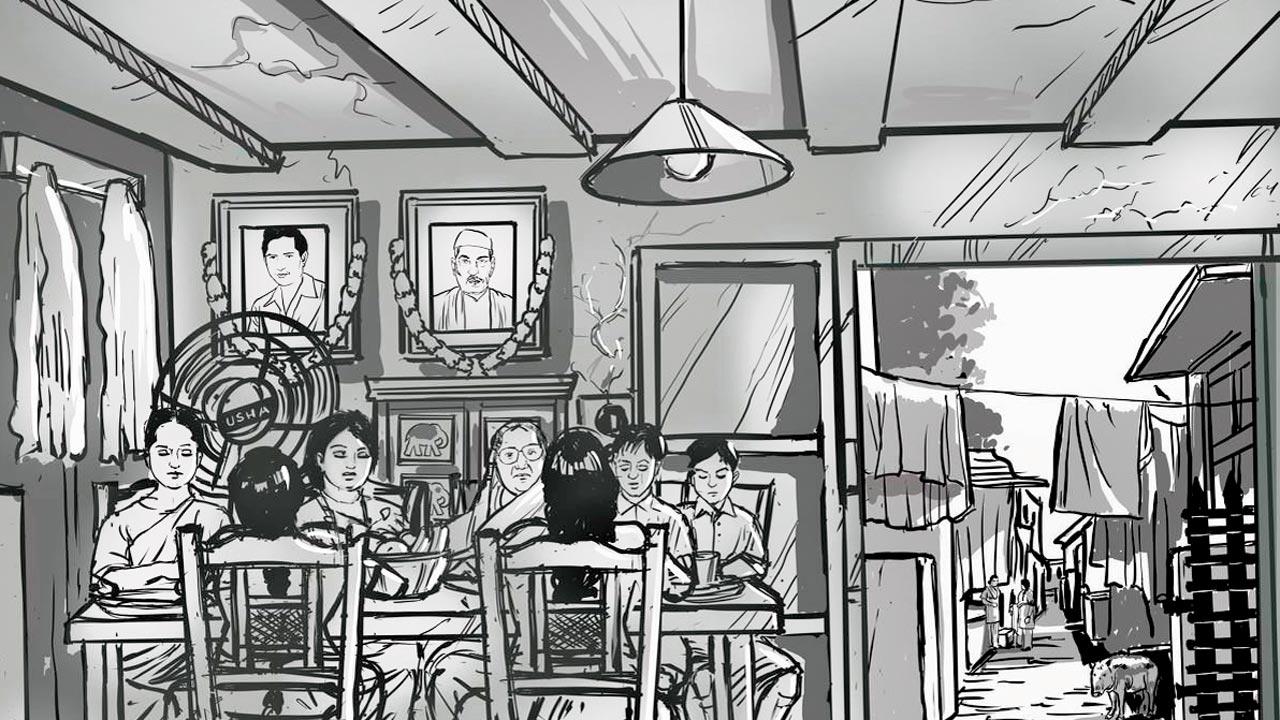
“It was the Sindhi refugees building homes for themselves that made the cooperative housing society so widespread in Bombay—the book describes the early years and how the phenomenon spread. These refugees also built a number of institutions that Mumbaikars now take for granted. Some of them, including educational institutions, came out of the refugee camps,” Aggarwal tells mid-day.
While the community settled in various parts of the country, Aggarwal says Mumbai is central to their story as a large population of the evacuees from Sindh made the city their home.
“The Motwanes of Gyan Ghar, Khar, as well as the Sawaldas Madhavdas family who had a bungalow in Santa Cruz, opened their homes to a large number of refugees, setting up tents in their building compounds and providing meals from huge cooking pots,” she says, adding, “Many Sindhi families set up businesses, while members of others took up jobs in various professions.”
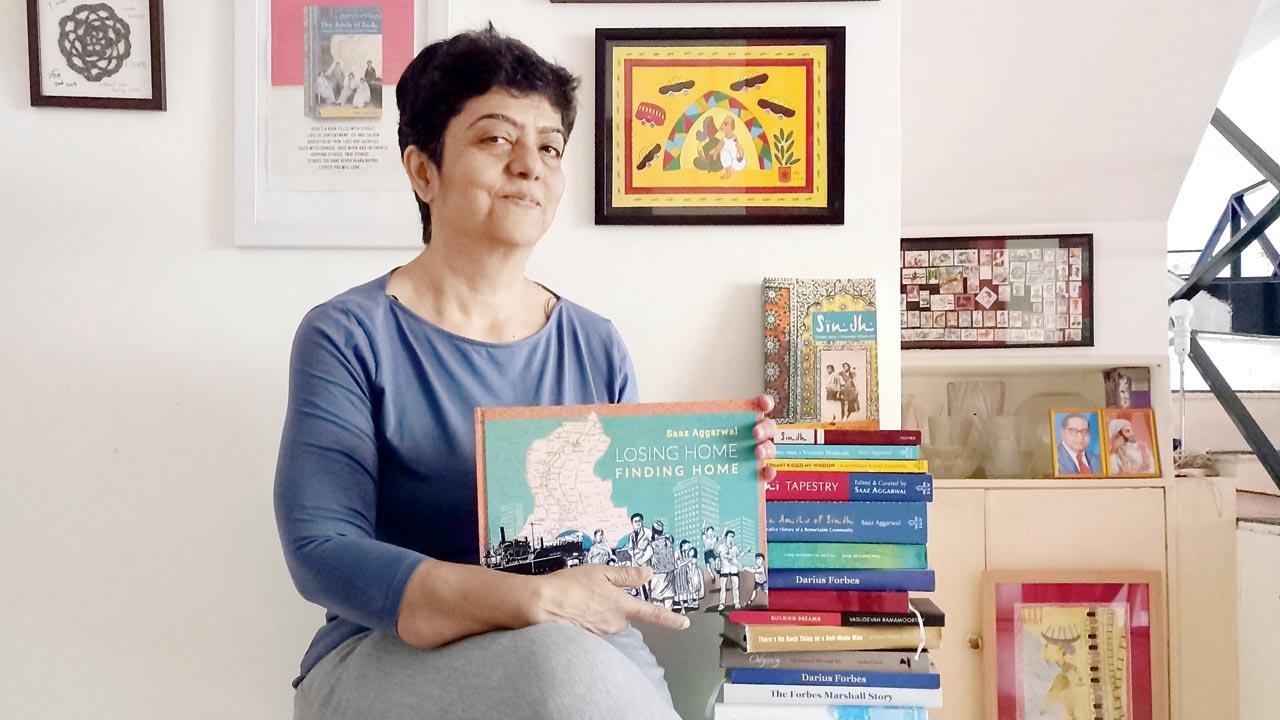
Aggarwal holds the book dear to her. “It’s filled with personal stuff, as along the way, my Sindhi mother started piping up with her ideas and opinions. I lost her in 2014,” she adds, “I’m really glad this book happened because she included many things that may not have occurred to me.”
Penning the story as a lived experience of her interviewee, Aggarwal says that she chose the ones that covered the widest span of common experience. “It gives a glimpse into the history of Sindh. So in that sense, it is not just a story book, but also a history book and a book of art,” she puts it.
But why did she choose to write another book on the community after already having authored her first book, Sindh: Stories from a Vanished Homeland, 2012 and compiling an anthology, Sindhi Tapestry, on the Sindhi identity in 2021? Aggarwal explains, “The Sindhi story started coming out 65 years after Partition. There was much less violence in Sindh than other Partition-affected regions and the Sindhis assimilated without fuss. These are some reasons why their story was neglected and it had to be told.”
For the new book, Aggarwal says references were taken from old photographs to have visual elements catering to the changing reading patterns around the world. “I wanted pictures in the book that showed real life and historically authentic scenes from Sindh. We did use photo references, but also detailed descriptions from Partition survivors, as can be seen in the illustrations accompanying the interviews. The illustrations make the storyteller familiar,” she says.
Drawing on from material she had accumulated from 10 years of research, Aggarwal says the book is for readers of all ages, but targeted specifically at the younger crowd. Preserving the past and looking forward to the community’s future link with it, Aggarwal says, “It contains a summary of my work on the diaspora, with all the messages that I want to pass on!”
First appeared here on 20 Nov 2022
12 November 2022
Interview: Mark-Anthony Falzon, author, The Sindhis; Selling Anything, Anywhere

By Saaz Aggarwal
Saaz: How did you manage all this research during lockdown?
Mark: My first and most intensive period of
fieldwork was in 1999-2000, in London, Malta and Mumbai. I was at the Gateway
of India for the millennium celebrations, and remember watching the first
sunrise of the third millennium at the lakeside in Borivali. I have since been
to India six more times, and the results of that work are contained in my
scholarly writing. I also draw on them in this book, though Selling
Anything, Anywhere is not aimed at the academic reader. I did intend to
spend some months updating my notes in India in 2020-1, but had to resort to
Zoom. There was also a fair bit of desk research, which was unaffected by
Covid.
2. Saaz: Was it really the Sindhi businessman Bhojoomal and his sons who founded Karachi?
Mark: If the memoirs of Seth Naomul Hotchand are
anything to go by, then yes. Hotchand was a merchant who lived in Karachi in
the nineteenth century, and who wrote the history of his family. He wrote that
his ancestor Seth Bhojoomal (who originally hailed from Sehwan in Sindh)
settled and established business in Kharrakbandar around 1720. The place,
however, quickly silted up, and Seth Bhojoomal and his fellow Sindhi merchants
relocated to a new place, later named Karachi, and developed it into a port of
considerable prominence.
3. Saaz: Claude Markovits published his findings about the Sindhi global traders in 1999. Why did it take so long for this centuries-old phenomenon, well known among the Sindhis themselves and the local populations where they live, to be identified and written about?
Mark: The Sindhworki network goes back to the
1850s, and involved traders from Hyderabad-Sindh who travelled quite literally
around the world in search of potential markets (usually in port cities,
especially in the earlier phase). That of the Shikarpuris goes back to at least
the early eighteenth century, and involved men from Shikarpur who ran an
elaborate banking trade in Central Asia. You’re right in saying that it took
scholars a long time to get the hint. Some early examples were Anita Chugani’s
1995 MA thesis on Sindhworkis in Japan, my undergraduate thesis on Sindhworkis
in Malta in 1996, Markovits’ benchmark book of 2000, and my book of 2005. I
think the reason is that Sindhis are so adaptable and flexible in their ways,
that they are easily overlooked as generic ‘Indians’. It took Markovits
considerable detective work to tease out the Shikarpuri presence in Central
Asia; and Sindhworkis can be even more difficult to identify as such. For all
their globetrotting and business acumen, Sindhis tend to fly under the
radar.
4. Saaz: Why are there no women in your book? There’s a brief indication of them as secret agents, and later the ones to prepare ‘poppadums’ and pickles which the men hawked. What about the many who had the gene and the connections and used them, the entrepreneurs and the captains of industry?
Mark: I do mention that in some contexts Sindhi
women are increasingly directly involved in business, and that women played a
key role in the circulation of information – crucial to business success – back
in Shikarpur and Hyderabad, and that well-connected Sindhi women in India and
elsewhere play an important part in the making of networks. Still, I think your
observation is justified. Mine is a partial story that leaves room for many
more. Some have already been told by Rita Kothari, Subhadra Anand and yourself,
and there’s a new breed of scholars (some are Sindhi women – Trisha
Lalchandani, Radhika Chakraborty and others) who are researching doctorates on
various aspects of Sindhis, and there's Aruna Madnani’s ‘Doorway to Sindh’
webinar series for her Sindhi Culture Foundation.
5. Saaz: “Poppadums”? Seriously Mark?
Mark: It’s papad I had in mind – not least since
I must have consumed hundreds in the course of my fieldwork. Sindhis can be
good hosts. You’re quite right to say papad is iconic. In part that’s because
of their unique peppery taste and blistered appearance (they always remind me
of Neapolitan pizza dough). But as I mention in the book, the making and
selling of papads and pickles is a defining episode in the story of how many
Sindhi refugees survived, and overcame, the economic hardships of Partition.
6. Saaz: Why does your book not mention the Sindhi tradition of philanthropy? And why do you have mostly only stories of plodders and small-time dealmakers - yes, the bell-curve people – but no representative of the huge population of rags-to-riches and the "my mother's blessings took me to where I am" people, who would have loved to be mentioned by name?
Mark: This book does not cover every aspect of
Sindhi business and culture. It was prescriptively intended as a short and
readable text, aimed at a popular audience. Besides, I cannot claim to have
worked with a mathematically representative sample of Sindhis. That's also why
this interview is welcome: it complements the contents.
Many Sindhis are in fact involved in
philanthropy. In the case of some of the big Sindhworki and other firms, this
can be as prominent as full-scale hospitals. But I’ve met people of more modest
means who funded and ran small homeopathic clinics, for example, in India and
elsewhere. I think the point really is that, contrary to some of the more toxic
stereotypes, Sindhis do not form isolated moneymaking enclaves; rather, they
are embedded in the societies they live in in various ways that include philanthropic
giving. Seth Naomul writes that on one auspicious occasion in 1805, his
ancestors spent “large sums of money in charity and in feeding Brahmins and
fakirs, and acquired such renown on account of their liberality that Bhats and
Brahmans chanted their benevolence in songs especially composed”.
7. Saaz: Did you observe cultural differences between the solidly Sindhi communities in Panama, Hong Kong, the Canaries (and other locations) through local influences?
Mark: You’ve put your finger on one of the most
fascinating parts of the Sindhi story. Simply put, Sindhis live in places.
The very first Sindhi I interviewed ran a
retail business in Malta which had been in the family for many decades. In a
corner of the shop was a little shelf, and on it photos of departed family
members and figures of Ganesha, Lakshmi and the Virgin Mary. When I asked, he
told me he was ‘100% Hindu’ but also a follower of a number of Catholic
devotions.
In Indonesia today there are about 10,000
Sindhis; many are businesspeople involved in many different lines. Perhaps the
best known is the production of sinetron (soap operas), which they have been
heavily invested in since the 1980s. The Sindhi producers even came up with an
innovative product, sinetron Ramadhan, which in turn evolved into a new genre
of Indonesian television known as sinetron Islam (Islamic soap opera). These
are two small examples of their linguistic, cultural, economic and social diversity.
And yet, Sindhis retain a strong sense of a networked cultural affinity, which
makes it possible for them to relocate should they wish or need to.
8. Saaz: Priya Ramani sent me an indignant message about the title of this book and I realised that it could be seen as demeaning to the community. I told her I’d ask you.
Mark: There’s the joke about the Sindhi on the
moon who approached Neil Armstrong and tried to sell him a flag – old and
weary, but telling. Everywhere you look you will find pockets of Sindhis
selling things as diverse as souvenirs, textiles, electronics and carpets;
financing films and developing real estate; manufacturing industrial plastics
in West Africa and snack foods in Ulhasnagar, making bespoke suits in Hong Kong
and running restaurants and hotels in dozens of locations worldwide. Selling
Anything, Anywhere is my homage to a tremendous lifeforce of adventure and
enterprise.
First published on 11 November 2022 in Hindustan Times
11 November 2022
An excerpt from Losing Home Finding Home in Scroll on Nov 10, 2022
How did the Partition affect the people of Sindh? Using true stories, a new book finds out
The Sindhworkis
Boolchand Mohinani left home when he was seventeen years
old, to work in a store in Ceylon. After three years, he joined his father in
the family business in the Dutch East Indies.
Many things have changed in the world. Ceylon is now Sri
Lanka, the Dutch East Indies is now Indonesia. But ambitious young men were
leaving Sindh to trade in other countries ever since 1850, more than seventy
years before Boolchand set out to seek his fortune. They sailed from Karachi,
carrying trunks filled with beautiful handicrafts made in Sindh, and got off at
ports to sell them. After all the goods were sold, they went back home and
brought more. In time, they set up stores of their own, and moved on to new
ports to expand their businesses. Soon there were many Sindhi stores in ports
around the world! The young men who ran them lived above their stores, and
sometimes even had to do their own housework, or cook for their bosses. When a
ship’s horn sounded, whatever time of day or night, they quickly ran down to
the dock to call customers to come and buy. Because they had started by selling
‘Sindhwork’, they became known as ‘Sindhworkis’.
The Sindhworkis led a hard life, and they could only visit
their families every two or three years. The ship journeys were long and
difficult. During the Second World War, the ship routes were closed and some
men were separated from their families for all the years of the war.
By this time, Boolchand had his own store. He and his wife
Muli and their three children lived in an apartment above the store. Three more
children were born to them during the war years.
Isolated in Indonesia by the war, Muli missed Sindh and her parents very much. When the war ended, they decided that she and the children would go and live in Hyderabad, as most Sindhworki families did. Boolchand would continue his business in Indonesia and visit his family every few years.
A life of luxury
Muli had grown up in Hyderabad. Her father, Khiomall, was a
Sindhworki too. He had lived in Durban, South Africa, his entire working life.
He visited his family in Hyderabad for two or three months every few years.
Sometimes, when he left to go back, he would take his wife Pappur and the
younger children along with him in the steamer ship on the twenty-day journey
to Durban. After some weeks or months, he would send them back.
 |
The drawing room of Muli’s childhood home. On the right you can see Ramchand, Boolchand’s brother, and their stepmother who have come to ‘see’ Muli and plan the wedding. Muli is in the centre with her parents Khiomall and Pappur on either side. Pappur’s brother Bullo’s is on the left with his children Gul, Rukmani and Gope. The goblets have a gold coin for the honoured guests to take home! This lifelike and accurate illustration is by Subhodeep Mukherjee
In
Hyderabad, Pappur lived like a queen. When
people visited on formal occasions, they would be served wine with a gold
guinea at the bottom of the glass, a stylish gift from their hosts! They owned
horse carriages made of pure silver.
When Muli married Boolchand, she went to live with him in
Indonesia. Life was quite different from what she was used to! But she soon
made friends with her neighbours and learnt how to cook delicious Indonesian
food, which her children would always love even when they went to live in other
countries. They spoke Sindhi to their parents, but Indonesian to each other and
their friends.
Tulsi was born soon after they returned to live in
Hyderabad, in July 1946. Just as the children started going to school and
getting used to their new lives, Partition took place. As trouble broke out on
the streets, there was no choice but to leave Sindh.
They got in the train, not knowing where they were going
 |
Quite a different situation from the one in which she grew up, Muli is seen here with her family. Another fleeing family occupies the berth above. Illustration by Subhodeep Mukherjee. |
By the time Partition took place, Muli’s father, Khiomall, had died.
Muli had to flee, taking care of her children and her
mother, Pappur, as well as her younger sister Sati, who had two babies of her
own. Luckily Muli’s son Jiwatram and daughter Mohini were older, and they could
help her. It was very difficult and frightening but Muli was a brave lady, and
so were the other women who had to leave Sindh with their children and family
elders. They did not know where they were going or what would happen to them.
Muli
and her family travelled in a very crowded train [S2] with
a few clothes and eatables they had packed, and crossed the new border. They
arrived in Ajmer and were taken to a camp and given a room in a row of rooms,
each occupied by many people. The toilets were in outhouses and people had to
stand in line and wait their turn.
After two weeks they left Ajmer and took a train to Delhi,
where they had to wait on the railway platform for a long time. The trains and
railway platforms were full of people like them, who had left their homes and
were looking for a safe place to settle. They talked to each other, asking
where they had come from and where they were going, trying to find out where
they could live and what they could do to earn money.
Muli and her family boarded the train to Patna, where her
cousin lived. Boolchand sent money to the family in Patna. It took nearly a
year before he was able to make arrangements for them to return to Indonesia,
and they were finally reunited.
Losing Home, Finding Home
Saaz Aggarwal
Illustrations by Subhodeep Mukherjee
black-and-white fountain
hardcover, 112 pages
for readers of all ages
Rs750
First appeared here on Nov 10, 2022
08 November 2022
Losing Home Q&A in Indian Express Pune
Sindhi voice is unlikely to carry much weight in public life: Saaz Aggarwal
Saaz Aggarwal talks about her book 'Losing Home, Finding Home', a culmination of 10 years of her research into the Sindhi diaspora.
Written by Parthasarathi Biswas

1) Tell us about this book.
How different is it from Sindh: Stories from a Vanished homeland? Why
did you feel the need to revisit the topic in this fashion?
I wrote SINDH: STORIES FROM
A VANISHED HOMELAND ten years ago. At that time, I knew nothing about Sindh or
the Sindhi diaspora. My mother was Sindhi, this much I knew. But nobody in the
family ever talked about what life had been like in Sindh, or any other aspect
of their Sindhiness. Even the language was restricted to those who had left
Sindh – everyone else heard it spoken around them, but it was never spoken TO us.
Yes, the food in my grandparents’ home was Sindhi food – but in our home, we
ate food from all over and Sindhi dishes only occasionally. In fact, my mother
would have to threaten violence before I could be convinced that
saeebhaji-khichdi – a traditional Sindhi meal comprising dal, rice and a basket
of vegetables – was good for health!
Well – over these years I
have read a lot, and interviewed around 300 elderly people who shared their
memories with me. I’m much more familiar with the subject than I was when I
wrote the first book, more comfortable with my thoughts and feelings about it.
Why I chose this format,
with so many high-quality images, is the knowledge that reading habits are
transforming – as they have always done over the centuries – and a visual
aspect is essential to communication with coming generations. I was very
fortunate to find a senior artist, Subhodeep Mukherjee, who has created
detailed and historically authentic illustrations to accompany each story.
Also, the text is very simple to read. And it tells pretty much the whole
story, with all the messages that I want to pass on!
2) Historical research
about exodus of Sindh is far and few between. I think yours would be the first
such book which looked into this incident of Indian partitions. Why have the
community and historians been lukewarm in research the human and historical
angle of this?
The Sindh Partition story
paled into insignificance for various reasons, most crucial of which is that
Sindh was never partitioned. It was given intact to Pakistan.
Sindh also faced far less
violence than Punjab, where almost every single family experienced barbaric
atrocity. The widespread exodus from Sindh took place some months after
Partition, when Sindh was occupied by large numbers of Partition-affected
refugees from other parts of the newly-divided India. This
may be the main reason why people who left Sindh considered themselves the
lucky ones and did not feel they had a story to tell. In any case – nobody was
listening, nobody wanted to know, nobody cared.
The Sindhis addressed their
trauma with stoic acceptance. They were role-model ‘refugees’ who started from
scratch. They found opportunities to earn their living by filling gaps and
providing necessities, and became useful citizens, contributing to the
communities they settled in. They integrated seamlessly into these communities,
adapting to new ways of living. These attributes – shown by an overwhelming
majority of the community – made them invisible.
While things have now changed
and there is a lot of interest in Sindhis, both from within the community as
well as from others who have begun to notice this tremendous phenomenon with
new respect, the Sindhi voice is unlikely to carry much weight in public life
for the simple reason that they are too few in number to form a significant vote
bank.
3) What were the main
sources of information for this book? How difficult or easy was for you to pen
this? Can you share some incidents or excerpts which touched you more as a
human than say an author?
This book is the
culmination of my 10 years of research into the Sindhi diaspora and I’ve tried
to include in it all that I’ve learnt, in particular all the messages I want to
pass on to future generations! This includes social, historical and
anthropological aspects of Sindhis as a community, and various aspects of the
Sindhi identity.
One of my biggest insights
in this journey has been the way the language was lost. Parents stopped
speaking to their children in their mother tongue, perhaps knowing that to have
a better chance in the world, they needed to be expert in local languages. I
realise now that most of us were never spoken to in Sindhi, never expected to
reply in Sindhi. However, there is a poignancy in the fact that Sindhi is a language that you only hear in the homes of relatives.
It is the language of intimacy, the language of the lost country. It is the
language you hear your grandparents speak to each other and to those of their
children who knew Sindh – never to you. Because you had never known Sindh, and
it would be impossible to explain anything as important, as essential, and as
complicated as that.
4) How personal is this
book? Is it just a relook at the exodus, or is it a personal journey about
losing and finding home?
The book is a collection of
personal accounts. It attempts to convey all that Sindh was to the Hindus who
lost their homeland, the journeys they undertook when they lost it, the heroic
rebuilding of their lives, the way they adapted, they way they ignored the
prejudice and stereotypes they faced, the way they contributed.
As a writer and oral
historian, I specialise in working with people to write their memoirs. It was
this that led me to write my first book on Sindh. For LOSING HOME FINDING HOME,
I had planned to write each story in the voice of its central character.
However, as I wrote, my mother’s thoughts and ideas began to enter each
narrative. I lost my mother nearly 8 years ago – and here she was, piping up insistently
and inserting her opinions, much as she had always done!
I soon decided to let her
tell the story, and the book is written in her voice. I’m really glad this
happened, because I found myself writing things that would not have occurred to
me without her inputs, essential aspects of the losing and the finding. It’s
extraordinary how parents leave traces of themselves inside one, long after
they are gone.
So yes – the book is
intensely personal. But at the same time, it is also as mainstream and
comprehensive as anything can be.
First appeared here on 7 Nov 2022
Subscribe to:
Comments (Atom)