

26 December 2022
What we read in 2022: The News on Sunday 25 Dec 2022
As we bid adieu to 2022, TNS turns to South Asian writers and authors to ask them about the titles they read this year that have stayed with them. Here, in alphabetical order, is what they say: What we read in 2022


20 December 2022
Episode 308: Saaz Aggarwal Enters a Vanished Homeland
From The Seen and The Unseen by Amit Varma
This post features a rich four-hour oral history interview with Saaz Aggarwal, recorded as Episode 308 of Amit Varma's podcast The Seen and the Unseen on 19 December 2022. In the conversation she traces her life, her writing, and the enduring importance of Sindh in her imagination and work. The discussion spans personal memory, cultural inheritance, literary labour, the experience of displacement and revival — and helps us understand how one “vanished homeland” can remain a persistent source of identity, exploration and creative energy.
I found the interview highly engaging — it moves across many terrain: family history, Partition’s legacies, the role of the Sindhi diaspora, the process of publishing, and the forging of community in unexpected places. For those interested in Sindhi heritage, Partition studies, and literary memoir, it offers deep insight and many resonant moments.
04 December 2022
Review of My Silk Road by Ram Gidoomal for thewire.in
Book Review: An Intimate Glimpse Into the Life of a Sindhi ‘British Asian Refugee

The most striking – the most intense – experience Ram Gidoomal describes in his memoirs is the feeling that overwhelmed him when he arrived in Bombay at the age of 14. Suddenly, unexpectedly, for the first time in his life, he knew what it felt to fit in. It brought home the paradox of “home” for an immigrant: on one side homesickness for the country of origin, a sense of cultural belonging, allies in appearance, and the freedom from fear these bring. And on the other, the cords of daily life that tie one to the birthplace and local community.
Ram’s family endured the transition from
citizen to refugee twice. Displaced both times by political whim, they
experienced a harsh wrenching from community, culture, status and education, and
were summarily swept from wealth and comfort to situations of continued struggle
– twice. Once as refugees when the Indian subcontinent was partitioned and
Pakistan was formed, and the second when his family was removed from Kenya. As
a teenager he would discover, in immigration queues, that he was an “alien”.
And, despite his academic brilliance and significant contribution to early
workplaces, he would remain painfully conscious that he was different.
In this book about his life, Gidoomal begins
by describing his happy childhood in Kenya, followed by the challenges of adapting
to Britain in the late 1960s – unwelcoming, and one where this family with a
multinational trading operation begins afresh with a corner shop – and yet an
obvious choice for the time.
There are intimate glimpses into a family
of large and complex but congenial groups, and the poignancy of family
tragedies including the loss of his birth father and then of his father-figure
uncle who brought him up; precious memories handed down from the past,
including those of links to the lost homeland of Sindh. There are fascinating
peeps into business practices and secret codes. Later, during his blissful days
with a young family in Switzerland, he was that role-model father who changed
his working hours so that he could spend time with his children, returning to
office after they went to bed. As the years passed, Ram moved from his life in
the corporate world to one centred on social issues and philanthropy, using his
business skills to transform others’ lives. His contribution earned him a CBE,
Commander of the British Empire, from the Queen of England in 1998.
In between comes a huge, surprising transformation:
“By my early twenties, I had lost two fathers but gained a heavenly one in
God.”
This wholehearted embracing of Jesus is
disconcerting, coming from one whose community sacrificed all they had to
escape conversion. As a child in a Sindhi family, Ram grew up Hindu with Sikh
influences. At the Aga Khan School in Mombasa, he absorbed Islamic teachings. The
choice he later made, with the backdrop of his exceptional intelligence and
crystal-clear rationality, resulted from the pull of faith. Succumbing to the
warmth of its embrace, he selected a life of devotion to the Church.
Through it all, his Sindhiness remained
intact. He writes of his feeling of comfort on reading Matthew chapter 27 verse
59, about Joseph of Arimathea wrapping the body of Jesus in cloth: “The Greek
word for this cloth is Sindhon, a cloth from Sindh. A cloth created in my homeland,
holding the body of Christ.”
Indeed, the Sindhiness pervades his life:
English was the language of instruction but Sindhi was the language his mother
spoke to him in, the language the old men swore in, the language he was scolded
in. When he fell in love, it was to a highly eligible Sindhi girl – one who,
however, was initially forbidden to him as she was of another “caste”. Sunita
was from a progressive Amil family, too progressive to consider caste and perhaps
just worried about how she would adapt in his traditional Bhaiband family. Indeed,
Ram Gidoomal observed with admiration that his father-in-law treated his
daughters and sons equally, inspiring him to do the same with his own children.
One of the most prominent themes of this
book is Ram Gidoomal’s tremendous network of relationships in every area of
life. As a young executive in the 1970s, his complacent and supercilious managers
failed to comprehend this tremendous asset which could have taken the bank into
new markets with valuable new customers. For Ram, the connections were simply a
way of life, partly the community and business networks inherited from his
family; partly his own aptitude to thrive on and develop relational networks – ties
of location as much as shared cultural traditions among the diaspora flung
across the continents. Working at Inlaks, a global company with a huge base in
Nigeria, he could speak in Sindhi with the senior executives who preferred to
do so when communicating confidential commercial information.
This book has an elegant story-telling
style, weaving in humour, and creating a build-up of suspense as the plot
unfolds. Despite being put together by a professional writer, Ram Gidoomal’s voice
comes through clearly and is the same as in his 1997 UK Maharajas which
was also written by a professional. Through
the book, Ram Gidoomal’s personal motto stands out clearly: “Don’t let what you
can’t do stop you from doing what you can.”
My Silk Road
The Adventures & Sturggles of a British Asian Refugee
Ram Gidoomal CBE
Pippa Rann books & media
MRP Rs799
270 pages
Review by Saaz Aggarwal
Published on 4 December 2022
https://thewire.in/books/ram-gidoomal-book-review-my-silk-road
28 November 2022
Lajwanti Shahani Stories of Sindh - Loss of Homeland | Interview with Saaz Aggarwal | Archaeo Talks 6 | 27 Nov 2022
In today’s ArchaeoTalks, Lajwanti Shahani talks to Saaz Aggarwal who has recently released her book on the Sindhi community with more curated human stories of the Partition of India in 1947.
This is a story about lost homeland, reinvented lives… eventually loss of language and culture… It also begs the question of a generational trauma. A story which the newer generations of Sindhis are now beginning to engage in.
Saaz talks about her latest book titled Losing Home, Finding Home as well as her experience with the Sindhi people she has interviewed over the years. You can check out this one and all her previous books at Amazon on the link given below.
https://www.amazon.in/Books-Saaz-Aggarwal/...
Thank you, viewers, for joining us today. Please like, share and subscribe to our channel, and don’t forget to hit that bell icon. Also, you can support our work by sponsoring a video or through paid promotions. Please contact us by email on ind.hist.arch@gmail.com
Namaste!
23 November 2022
Review of Losing Home Finding Home by Kalyani Sardesai in Pune Mirror
Facing loss, finding ground
It’s funny how our parents remain inside us long after they are gone! observes Saaz.

Little wonder then that the narrative of Losing Home, Finding Home, Saaz’s latest work on the Sindhi community amongst others she has written on the Sindhis, is narrated in the voice of her late mother Situ Savur (herself a Sindhi.) It is also a fitting chronicle of a hard-working community that has embraced Pune after losing its home state to partition.
I’m glad I surrendered to her frequent reminders and comments and let her tell the story as many things emerged which may not have otherwise occurred to me to include, she says.
For those who came in late, Saaz Aggarwal has written several books, including quite a few about the Sindhi community. While some of them have documented the community through the stories of individuals and families she has interviewed, some of her work has also been very personal, with insights into what happened to the Sindhi community through the experiences of her mother’s family. For this book, she selected stories that would give an overview of not just Partition but also the very interesting and little-known recent history of the community and how it played a role in the rehabilitation after Partition.
https://punemirror.com/pune-mirror-explore/facing-loss-finding-ground/ Nov 22, 2022
20 November 2022
Review of Losing Home Finding Home by Shreya Jachak in Sunday Mid-day
A new illustrated book by Saaz Aggarwal traces the stories of Sindhi refugees in India
Uprooted from their roots in Pakistan during the
Partition of 1947, the Sindhi community that built life from scratch in India
are celebrated in a new illustrated book by one of their own

Khushiram Kundnani
It must have been an arduous journey for educationist
Khushiram Kundnani, then principal and professor at Government College
University, Hyderabad (Sindh), to traverse through the blood-smeared terrain of
India-Pakistan during the Partition of 1947. More so, because Kundnani did not
travel alone. He carried his college with him to the shores of Mumbai. Bags of
library books and laboratory equipment as companions, Kundnani sought refuge in
a cramped accommodation. He walked the streets of Mumbai looking for a place to
reestablish his college. Every week he wrote postcards to his former
colleagues, cheering them up, promising them that it was just a matter of time
before they would get their jobs and their students back. In just another two
years, the refugee had fulfilled past promises and established the RD National
College in Bandra in 1949.
And this was not the only institution that Kundnani and
other Sindhi refugees established in Mumbai. Now, a just-released book by
author Saaz Aggarwal traces the many stories of Sindhi refugees in the backdrop
of the Partition, what they lost but more of what they found on Indian shores.
Losing Home, Finding Home, is a labour of a decade-long body of research that
Aggarwal conducted around the Sindhi community. A book accompanied with
illustrations by Subhodeep Mukherjee, it brings back true stories, but not
those of trauma but of shared experiences and perseverance.
“It was the Sindhi refugees building homes for themselves that made the cooperative housing society so widespread in Bombay—the book describes the early years and how the phenomenon spread. These refugees also built a number of institutions that Mumbaikars now take for granted. Some of them, including educational institutions, came out of the refugee camps,” Aggarwal tells mid-day.
While the community settled in various parts of the country, Aggarwal says Mumbai is central to their story as a large population of the evacuees from Sindh made the city their home.
“The Motwanes of Gyan Ghar, Khar, as well as the Sawaldas Madhavdas family who had a bungalow in Santa Cruz, opened their homes to a large number of refugees, setting up tents in their building compounds and providing meals from huge cooking pots,” she says, adding, “Many Sindhi families set up businesses, while members of others took up jobs in various professions.”
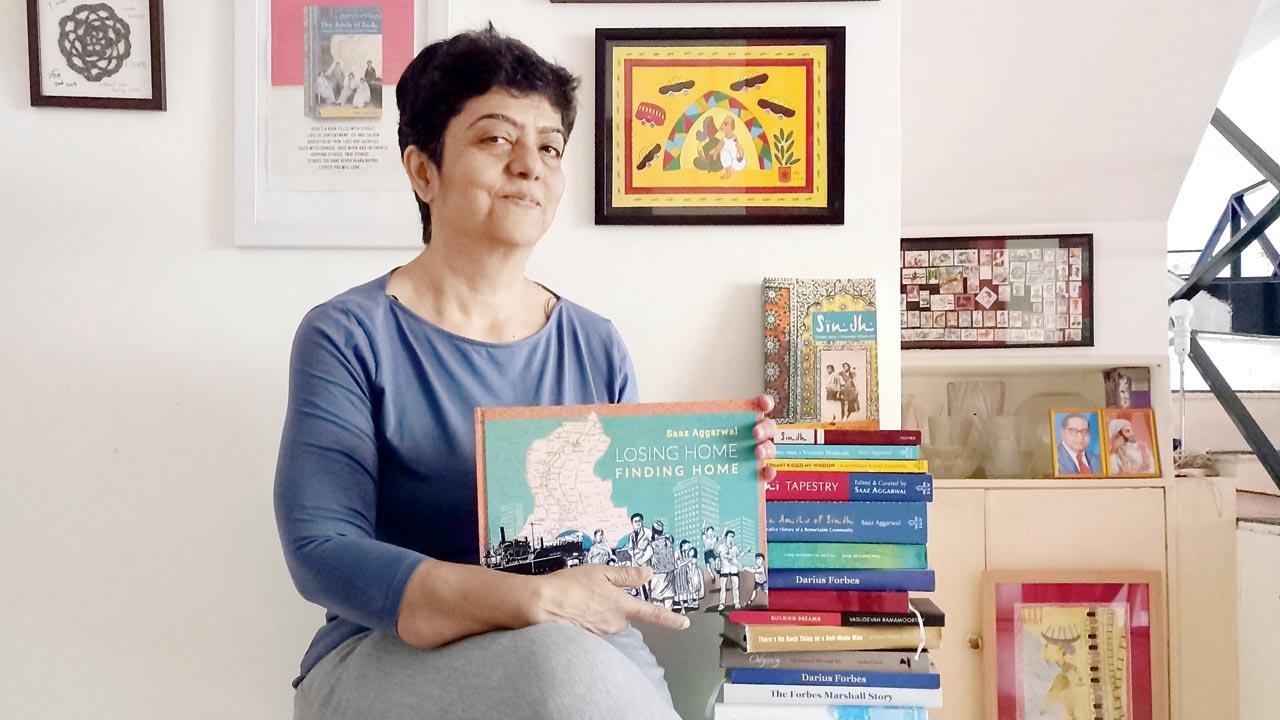
Aggarwal holds the book dear to her. “It’s filled with personal stuff, as along the way, my Sindhi mother started piping up with her ideas and opinions. I lost her in 2014,” she adds, “I’m really glad this book happened because she included many things that may not have occurred to me.”
Penning the story as a lived experience of her interviewee, Aggarwal says that she chose the ones that covered the widest span of common experience. “It gives a glimpse into the history of Sindh. So in that sense, it is not just a story book, but also a history book and a book of art,” she puts it.
But why did she choose to write another book on the community after already having authored her first book, Sindh: Stories from a Vanished Homeland, 2012 and compiling an anthology, Sindhi Tapestry, on the Sindhi identity in 2021? Aggarwal explains, “The Sindhi story started coming out 65 years after Partition. There was much less violence in Sindh than other Partition-affected regions and the Sindhis assimilated without fuss. These are some reasons why their story was neglected and it had to be told.”
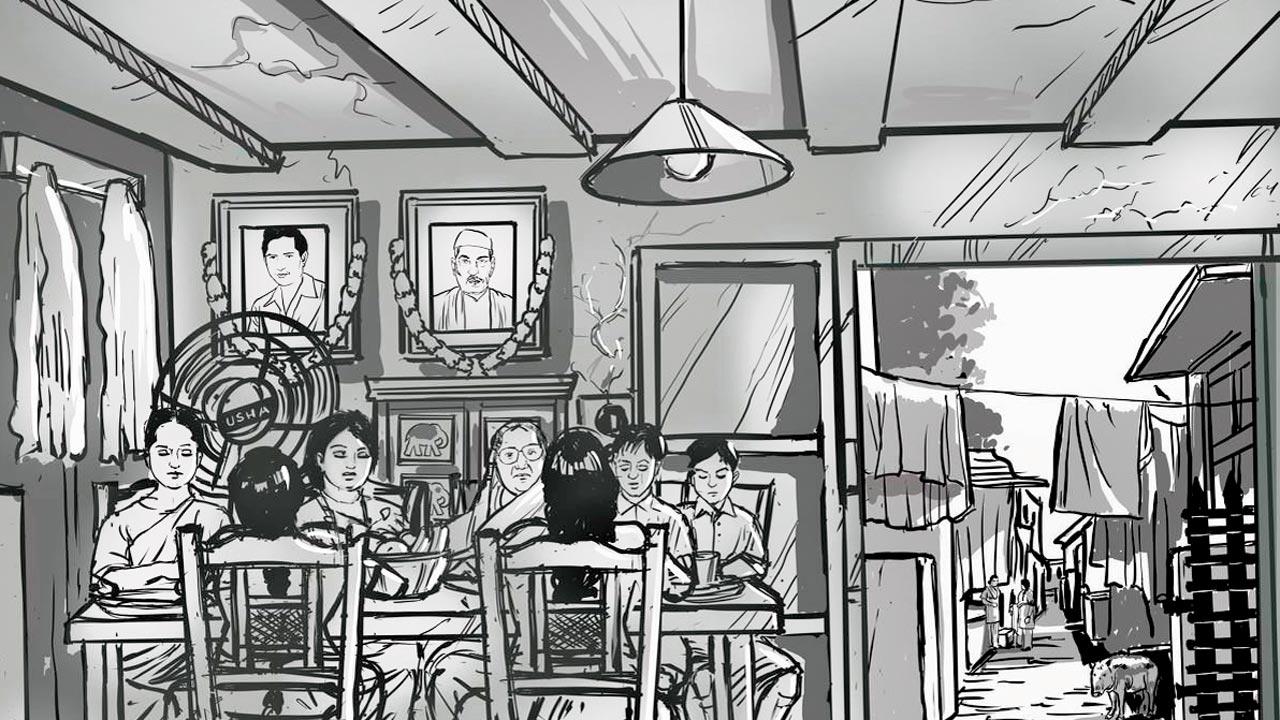
For the new book, Aggarwal says references were taken from old photographs to have visual elements catering to the changing reading patterns around the world. “I wanted pictures in the book that showed real life and historically authentic scenes from Sindh. We did use photo references, but also detailed descriptions from Partition survivors, as can be seen in the illustrations accompanying the interviews. The illustrations make the storyteller familiar,” she says.
Drawing on from material she had accumulated from 10 years of research, Aggarwal says the book is for readers of all ages, but targeted specifically at the younger crowd. Preserving the past and looking forward to the community’s future link with it, Aggarwal says, “It contains a summary of my work on the diaspora, with all the messages that I want to pass on!”
First appeared here on 20 Nov 2022
12 November 2022
Interview: Mark-Anthony Falzon, author, The Sindhis; Selling Anything, Anywhere

By Saaz Aggarwal
Saaz: How did you manage all this research during lockdown?
Mark: My first and most intensive period of
fieldwork was in 1999-2000, in London, Malta and Mumbai. I was at the Gateway
of India for the millennium celebrations, and remember watching the first
sunrise of the third millennium at the lakeside in Borivali. I have since been
to India six more times, and the results of that work are contained in my
scholarly writing. I also draw on them in this book, though Selling
Anything, Anywhere is not aimed at the academic reader. I did intend to
spend some months updating my notes in India in 2020-1, but had to resort to
Zoom. There was also a fair bit of desk research, which was unaffected by
Covid.
2. Saaz: Was it really the Sindhi businessman Bhojoomal and his sons who founded Karachi?
Mark: If the memoirs of Seth Naomul Hotchand are
anything to go by, then yes. Hotchand was a merchant who lived in Karachi in
the nineteenth century, and who wrote the history of his family. He wrote that
his ancestor Seth Bhojoomal (who originally hailed from Sehwan in Sindh)
settled and established business in Kharrakbandar around 1720. The place,
however, quickly silted up, and Seth Bhojoomal and his fellow Sindhi merchants
relocated to a new place, later named Karachi, and developed it into a port of
considerable prominence.
3. Saaz: Claude Markovits published his findings about the Sindhi global traders in 1999. Why did it take so long for this centuries-old phenomenon, well known among the Sindhis themselves and the local populations where they live, to be identified and written about?
Mark: The Sindhworki network goes back to the
1850s, and involved traders from Hyderabad-Sindh who travelled quite literally
around the world in search of potential markets (usually in port cities,
especially in the earlier phase). That of the Shikarpuris goes back to at least
the early eighteenth century, and involved men from Shikarpur who ran an
elaborate banking trade in Central Asia. You’re right in saying that it took
scholars a long time to get the hint. Some early examples were Anita Chugani’s
1995 MA thesis on Sindhworkis in Japan, my undergraduate thesis on Sindhworkis
in Malta in 1996, Markovits’ benchmark book of 2000, and my book of 2005. I
think the reason is that Sindhis are so adaptable and flexible in their ways,
that they are easily overlooked as generic ‘Indians’. It took Markovits
considerable detective work to tease out the Shikarpuri presence in Central
Asia; and Sindhworkis can be even more difficult to identify as such. For all
their globetrotting and business acumen, Sindhis tend to fly under the
radar.
4. Saaz: Why are there no women in your book? There’s a brief indication of them as secret agents, and later the ones to prepare ‘poppadums’ and pickles which the men hawked. What about the many who had the gene and the connections and used them, the entrepreneurs and the captains of industry?
Mark: I do mention that in some contexts Sindhi
women are increasingly directly involved in business, and that women played a
key role in the circulation of information – crucial to business success – back
in Shikarpur and Hyderabad, and that well-connected Sindhi women in India and
elsewhere play an important part in the making of networks. Still, I think your
observation is justified. Mine is a partial story that leaves room for many
more. Some have already been told by Rita Kothari, Subhadra Anand and yourself,
and there’s a new breed of scholars (some are Sindhi women – Trisha
Lalchandani, Radhika Chakraborty and others) who are researching doctorates on
various aspects of Sindhis, and there's Aruna Madnani’s ‘Doorway to Sindh’
webinar series for her Sindhi Culture Foundation.
5. Saaz: “Poppadums”? Seriously Mark?
Mark: It’s papad I had in mind – not least since
I must have consumed hundreds in the course of my fieldwork. Sindhis can be
good hosts. You’re quite right to say papad is iconic. In part that’s because
of their unique peppery taste and blistered appearance (they always remind me
of Neapolitan pizza dough). But as I mention in the book, the making and
selling of papads and pickles is a defining episode in the story of how many
Sindhi refugees survived, and overcame, the economic hardships of Partition.
6. Saaz: Why does your book not mention the Sindhi tradition of philanthropy? And why do you have mostly only stories of plodders and small-time dealmakers - yes, the bell-curve people – but no representative of the huge population of rags-to-riches and the "my mother's blessings took me to where I am" people, who would have loved to be mentioned by name?
Mark: This book does not cover every aspect of
Sindhi business and culture. It was prescriptively intended as a short and
readable text, aimed at a popular audience. Besides, I cannot claim to have
worked with a mathematically representative sample of Sindhis. That's also why
this interview is welcome: it complements the contents.
Many Sindhis are in fact involved in
philanthropy. In the case of some of the big Sindhworki and other firms, this
can be as prominent as full-scale hospitals. But I’ve met people of more modest
means who funded and ran small homeopathic clinics, for example, in India and
elsewhere. I think the point really is that, contrary to some of the more toxic
stereotypes, Sindhis do not form isolated moneymaking enclaves; rather, they
are embedded in the societies they live in in various ways that include philanthropic
giving. Seth Naomul writes that on one auspicious occasion in 1805, his
ancestors spent “large sums of money in charity and in feeding Brahmins and
fakirs, and acquired such renown on account of their liberality that Bhats and
Brahmans chanted their benevolence in songs especially composed”.
7. Saaz: Did you observe cultural differences between the solidly Sindhi communities in Panama, Hong Kong, the Canaries (and other locations) through local influences?
Mark: You’ve put your finger on one of the most
fascinating parts of the Sindhi story. Simply put, Sindhis live in places.
The very first Sindhi I interviewed ran a
retail business in Malta which had been in the family for many decades. In a
corner of the shop was a little shelf, and on it photos of departed family
members and figures of Ganesha, Lakshmi and the Virgin Mary. When I asked, he
told me he was ‘100% Hindu’ but also a follower of a number of Catholic
devotions.
In Indonesia today there are about 10,000
Sindhis; many are businesspeople involved in many different lines. Perhaps the
best known is the production of sinetron (soap operas), which they have been
heavily invested in since the 1980s. The Sindhi producers even came up with an
innovative product, sinetron Ramadhan, which in turn evolved into a new genre
of Indonesian television known as sinetron Islam (Islamic soap opera). These
are two small examples of their linguistic, cultural, economic and social diversity.
And yet, Sindhis retain a strong sense of a networked cultural affinity, which
makes it possible for them to relocate should they wish or need to.
8. Saaz: Priya Ramani sent me an indignant message about the title of this book and I realised that it could be seen as demeaning to the community. I told her I’d ask you.
Mark: There’s the joke about the Sindhi on the
moon who approached Neil Armstrong and tried to sell him a flag – old and
weary, but telling. Everywhere you look you will find pockets of Sindhis
selling things as diverse as souvenirs, textiles, electronics and carpets;
financing films and developing real estate; manufacturing industrial plastics
in West Africa and snack foods in Ulhasnagar, making bespoke suits in Hong Kong
and running restaurants and hotels in dozens of locations worldwide. Selling
Anything, Anywhere is my homage to a tremendous lifeforce of adventure and
enterprise.
First published on 11 November 2022 in Hindustan Times
11 November 2022
An excerpt from Losing Home Finding Home in Scroll on Nov 10, 2022
How did the Partition affect the people of Sindh? Using true stories, a new book finds out
The Sindhworkis
Boolchand Mohinani left home when he was seventeen years
old, to work in a store in Ceylon. After three years, he joined his father in
the family business in the Dutch East Indies.
Many things have changed in the world. Ceylon is now Sri
Lanka, the Dutch East Indies is now Indonesia. But ambitious young men were
leaving Sindh to trade in other countries ever since 1850, more than seventy
years before Boolchand set out to seek his fortune. They sailed from Karachi,
carrying trunks filled with beautiful handicrafts made in Sindh, and got off at
ports to sell them. After all the goods were sold, they went back home and
brought more. In time, they set up stores of their own, and moved on to new
ports to expand their businesses. Soon there were many Sindhi stores in ports
around the world! The young men who ran them lived above their stores, and
sometimes even had to do their own housework, or cook for their bosses. When a
ship’s horn sounded, whatever time of day or night, they quickly ran down to
the dock to call customers to come and buy. Because they had started by selling
‘Sindhwork’, they became known as ‘Sindhworkis’.
The Sindhworkis led a hard life, and they could only visit
their families every two or three years. The ship journeys were long and
difficult. During the Second World War, the ship routes were closed and some
men were separated from their families for all the years of the war.
By this time, Boolchand had his own store. He and his wife
Muli and their three children lived in an apartment above the store. Three more
children were born to them during the war years.
Isolated in Indonesia by the war, Muli missed Sindh and her parents very much. When the war ended, they decided that she and the children would go and live in Hyderabad, as most Sindhworki families did. Boolchand would continue his business in Indonesia and visit his family every few years.
A life of luxury
Muli had grown up in Hyderabad. Her father, Khiomall, was a
Sindhworki too. He had lived in Durban, South Africa, his entire working life.
He visited his family in Hyderabad for two or three months every few years.
Sometimes, when he left to go back, he would take his wife Pappur and the
younger children along with him in the steamer ship on the twenty-day journey
to Durban. After some weeks or months, he would send them back.
 |
The drawing room of Muli’s childhood home. On the right you can see Ramchand, Boolchand’s brother, and their stepmother who have come to ‘see’ Muli and plan the wedding. Muli is in the centre with her parents Khiomall and Pappur on either side. Pappur’s brother Bullo’s is on the left with his children Gul, Rukmani and Gope. The goblets have a gold coin for the honoured guests to take home! This lifelike and accurate illustration is by Subhodeep Mukherjee
In
Hyderabad, Pappur lived like a queen. When
people visited on formal occasions, they would be served wine with a gold
guinea at the bottom of the glass, a stylish gift from their hosts! They owned
horse carriages made of pure silver.
When Muli married Boolchand, she went to live with him in
Indonesia. Life was quite different from what she was used to! But she soon
made friends with her neighbours and learnt how to cook delicious Indonesian
food, which her children would always love even when they went to live in other
countries. They spoke Sindhi to their parents, but Indonesian to each other and
their friends.
Tulsi was born soon after they returned to live in
Hyderabad, in July 1946. Just as the children started going to school and
getting used to their new lives, Partition took place. As trouble broke out on
the streets, there was no choice but to leave Sindh.
They got in the train, not knowing where they were going
 |
Quite a different situation from the one in which she grew up, Muli is seen here with her family. Another fleeing family occupies the berth above. Illustration by Subhodeep Mukherjee. |
By the time Partition took place, Muli’s father, Khiomall, had died.
Muli had to flee, taking care of her children and her
mother, Pappur, as well as her younger sister Sati, who had two babies of her
own. Luckily Muli’s son Jiwatram and daughter Mohini were older, and they could
help her. It was very difficult and frightening but Muli was a brave lady, and
so were the other women who had to leave Sindh with their children and family
elders. They did not know where they were going or what would happen to them.
Muli
and her family travelled in a very crowded train [S2] with
a few clothes and eatables they had packed, and crossed the new border. They
arrived in Ajmer and were taken to a camp and given a room in a row of rooms,
each occupied by many people. The toilets were in outhouses and people had to
stand in line and wait their turn.
After two weeks they left Ajmer and took a train to Delhi,
where they had to wait on the railway platform for a long time. The trains and
railway platforms were full of people like them, who had left their homes and
were looking for a safe place to settle. They talked to each other, asking
where they had come from and where they were going, trying to find out where
they could live and what they could do to earn money.
Muli and her family boarded the train to Patna, where her
cousin lived. Boolchand sent money to the family in Patna. It took nearly a
year before he was able to make arrangements for them to return to Indonesia,
and they were finally reunited.
Losing Home, Finding Home
Saaz Aggarwal
Illustrations by Subhodeep Mukherjee
black-and-white fountain
hardcover, 112 pages
for readers of all ages
Rs750
First appeared here on Nov 10, 2022
08 November 2022
Losing Home Q&A in Indian Express Pune
Sindhi voice is unlikely to carry much weight in public life: Saaz Aggarwal
Saaz Aggarwal talks about her book 'Losing Home, Finding Home', a culmination of 10 years of her research into the Sindhi diaspora.
Written by Parthasarathi Biswas

1) Tell us about this book.
How different is it from Sindh: Stories from a Vanished homeland? Why
did you feel the need to revisit the topic in this fashion?
I wrote SINDH: STORIES FROM
A VANISHED HOMELAND ten years ago. At that time, I knew nothing about Sindh or
the Sindhi diaspora. My mother was Sindhi, this much I knew. But nobody in the
family ever talked about what life had been like in Sindh, or any other aspect
of their Sindhiness. Even the language was restricted to those who had left
Sindh – everyone else heard it spoken around them, but it was never spoken TO us.
Yes, the food in my grandparents’ home was Sindhi food – but in our home, we
ate food from all over and Sindhi dishes only occasionally. In fact, my mother
would have to threaten violence before I could be convinced that
saeebhaji-khichdi – a traditional Sindhi meal comprising dal, rice and a basket
of vegetables – was good for health!
Well – over these years I
have read a lot, and interviewed around 300 elderly people who shared their
memories with me. I’m much more familiar with the subject than I was when I
wrote the first book, more comfortable with my thoughts and feelings about it.
Why I chose this format,
with so many high-quality images, is the knowledge that reading habits are
transforming – as they have always done over the centuries – and a visual
aspect is essential to communication with coming generations. I was very
fortunate to find a senior artist, Subhodeep Mukherjee, who has created
detailed and historically authentic illustrations to accompany each story.
Also, the text is very simple to read. And it tells pretty much the whole
story, with all the messages that I want to pass on!
2) Historical research
about exodus of Sindh is far and few between. I think yours would be the first
such book which looked into this incident of Indian partitions. Why have the
community and historians been lukewarm in research the human and historical
angle of this?
The Sindh Partition story
paled into insignificance for various reasons, most crucial of which is that
Sindh was never partitioned. It was given intact to Pakistan.
Sindh also faced far less
violence than Punjab, where almost every single family experienced barbaric
atrocity. The widespread exodus from Sindh took place some months after
Partition, when Sindh was occupied by large numbers of Partition-affected
refugees from other parts of the newly-divided India. This
may be the main reason why people who left Sindh considered themselves the
lucky ones and did not feel they had a story to tell. In any case – nobody was
listening, nobody wanted to know, nobody cared.
The Sindhis addressed their
trauma with stoic acceptance. They were role-model ‘refugees’ who started from
scratch. They found opportunities to earn their living by filling gaps and
providing necessities, and became useful citizens, contributing to the
communities they settled in. They integrated seamlessly into these communities,
adapting to new ways of living. These attributes – shown by an overwhelming
majority of the community – made them invisible.
While things have now changed
and there is a lot of interest in Sindhis, both from within the community as
well as from others who have begun to notice this tremendous phenomenon with
new respect, the Sindhi voice is unlikely to carry much weight in public life
for the simple reason that they are too few in number to form a significant vote
bank.
3) What were the main
sources of information for this book? How difficult or easy was for you to pen
this? Can you share some incidents or excerpts which touched you more as a
human than say an author?
This book is the
culmination of my 10 years of research into the Sindhi diaspora and I’ve tried
to include in it all that I’ve learnt, in particular all the messages I want to
pass on to future generations! This includes social, historical and
anthropological aspects of Sindhis as a community, and various aspects of the
Sindhi identity.
One of my biggest insights
in this journey has been the way the language was lost. Parents stopped
speaking to their children in their mother tongue, perhaps knowing that to have
a better chance in the world, they needed to be expert in local languages. I
realise now that most of us were never spoken to in Sindhi, never expected to
reply in Sindhi. However, there is a poignancy in the fact that Sindhi is a language that you only hear in the homes of relatives.
It is the language of intimacy, the language of the lost country. It is the
language you hear your grandparents speak to each other and to those of their
children who knew Sindh – never to you. Because you had never known Sindh, and
it would be impossible to explain anything as important, as essential, and as
complicated as that.
4) How personal is this
book? Is it just a relook at the exodus, or is it a personal journey about
losing and finding home?
The book is a collection of
personal accounts. It attempts to convey all that Sindh was to the Hindus who
lost their homeland, the journeys they undertook when they lost it, the heroic
rebuilding of their lives, the way they adapted, they way they ignored the
prejudice and stereotypes they faced, the way they contributed.
As a writer and oral
historian, I specialise in working with people to write their memoirs. It was
this that led me to write my first book on Sindh. For LOSING HOME FINDING HOME,
I had planned to write each story in the voice of its central character.
However, as I wrote, my mother’s thoughts and ideas began to enter each
narrative. I lost my mother nearly 8 years ago – and here she was, piping up insistently
and inserting her opinions, much as she had always done!
I soon decided to let her
tell the story, and the book is written in her voice. I’m really glad this
happened, because I found myself writing things that would not have occurred to
me without her inputs, essential aspects of the losing and the finding. It’s
extraordinary how parents leave traces of themselves inside one, long after
they are gone.
So yes – the book is
intensely personal. But at the same time, it is also as mainstream and
comprehensive as anything can be.
First appeared here on 7 Nov 2022
30 October 2022
Kindness in the time of Partition in USAWA LITERARY REVIEW
Kindness in the time of Partition
by Saaz Aggarwal
It is common knowledge that the 1947 Partition of the Indian
subcontinent was a time of extreme violence between the Hindus and Muslims. In
Punjab, men even killed their own daughters and wives, believing that they were
protecting them from a fate worse than death. Every family experienced loss of
life and limb, rape, abduction, separation and various forms of trauma.
Even as desperation and inflamed emotions led to a maniacal
frenzy of vicious destruction, other, softer, human emotions continued to
manifest, all along the new border as well as the areas in which riots and conflict
prevailed.
In my ten years of interviewing Sindhi Partition survivors,
one of the things that has struck me most is the many examples of kindness and
affection between the communities. The Sindh story is different for many
reasons, most significant of which is that Sindh was never partitioned. Sindh
also saw less violence. A turning point took place on 6 January 1948, when a
pogrom was conducted. Of the many who were saved by members of the other
community who went out of their way to help and protect them, at risk to their
own lives, here are a few.
Kartar’s story:
I was born in 1934, in the village Taib in Larkano district,
a small village belonging to the Jaisinghani families. We were zamindars. The
Bhutto family’s lands adjoined our village and we had frequent disputes over
water, which was sometimes scarce, but there was friendship and congeniality
between us too. The houses were made of brick – there was no concept of cement
or concrete in those days. We were well off, had a horse-driven cart with seats
for four, and a motorcycle, and employed a number of farmers who lived on the
land and tilled it. The house was large and our rooms were upstairs. Downstairs
was the autaak, a big room where the menfolk gathered. Their food was served to
them there. In Taib, we ate our meals sitting on cots. Women sat separately in
their section of the house. We had kitchen, bathroom, and toilets inside the
house. During the hot weather, we slept in the angan, the courtyard.
My father Jessaram Jaisinghani studied in Shikarpur and then
worked as a teacher in Dharamsabha High School. My mother and we children were
taken to live with him in Shikarpur when I was six years old. I had my primary
education in Shikarpur.
We spent our holidays in Karachi and on 14 August 1947 when
Pakistan was born, that is where we were. We had been thinking about migrating
to India but were still there on the fateful day of 6 January 1948.
That morning, my elder brother Nand was to take our chachi
to the city. Our neighbours on the ground floor were Muslims who had migrated
from Bihar a few months earlier. They must have known something was going to
happen, because they rushed to Nand and begged him not to leave the house that
day. They invited us to come and hide in their house where they would protect
us from harm. We were grateful, but what could we do? How could we go and stay
with people we hardly knew, who were of the other community?
These Muhajirs – as the migrants to Pakistan during
Partition are known as – understood our dilemma. They came to our house, hung
curtains on the windows and hoisted the Muslim League flag in the balcony. They
assured us that if a mob came they would point to the balcony and say that no Hindu
lived in the house. The mob came twice, but our kind neighbours saved us.
That day I saw terrible things that I will never forget.
People were being butchered in the streets. The Muhajirs told everyone who came
that there were only Muslims in the building and nobody disturbed us.
We left Karachi for good, sailing to Okha port in
Saurashtra. From Viramgam, we got into the Bombay train. But it was 30 January
1948, the day Gandhi was assassinated. Our train was terminated at Ahmedabad
station and everything was at a standstill. We stayed for one week on Platform
Number One. There were curfews. After some days, we moved to a sesame oil mill
which had been converted into a camp for refugees.
My father rented a house on the outskirts of Ahmedabad and
joined Mahatma Gandhi High School as a teacher. We had to walk twelve miles
every day to the school. It was a hard time but we never felt a sense of
poverty since we were always aware that we belonged to a noble, zamindar
family. As the years went by, our lives improved. My father became the
widely-respected principal of the school. I became an engineer and worked in
the corporate world. None of us ever forgot the Muhajirs who saved us on that
terrible day.
Triveni’s story:
Before marriage, my mother was Saraswati Ramchand Malkani.
The family lived in Malkani Ghitti, Hyderabad, Sindh. They were landlords,
wealthy for seven generations, owners of bunnyoon and buildings. In c1941 they
moved to live in Karachi, in Malkani Mansion on Bunder Road, opposite a Muslim cemetery.
Saraswati was the youngest of three sisters. Her father,
Ramchand, had died when she was just forty days old. The head of the family was
his brother Dr Sahijram. My mama Gurbaksh went to London to study and became a barrister,
and the other mama Ajit Singh was given charge of the family lands, a holding
of more than 3000 acres.
When Partition came, Malkani Mansion was attacked by a mob.
They ransacked the doctor’s clinic on the ground floor. As they climbed to the
next floor, loot maar kayoon – they pillaged the houses on the first
floor, then attacked the second floor.
On the third floor they met a Muslim who stopped them,
saying that there were no Hindus on the fourth floor. When they refused to
believe him, he swore on the holy Quran, insisting that there were no Hindus upstairs.
It was this false promise, made on the Holy Quran, that saved my mother and her
family. If it hadn’t been for that Muslim, I would not be here today.
Motilal’s poem
The experience of the 6 January 1948 Karachi pogrom is also
beautifully depicted in this poem by Motilal Jotwani, a child when the incident
took place. His father was a teacher in Karachi and they rented two rooms in a
building belonging to a devout Muslim. He was huddled that day along with other
members of the family in a small storeroom of the house, old enough to imagine
the consequences although his younger brother and sister were not. Allahdino –
which means ‘given by god’ – let the rioters take what they wanted, and then
spent the rest of the day singing songs of Kabir with the author’s father.
Cities Ran Amuck
by Motilal Jotwani
Streets
roared: “Allah-o-Akbar!”
“Har
har Mahadev!”
In
Karachi, on 6 January 1948,
huddled
in a store room,
we
waited with bated breath.
The
world, it seemed,
would
come to a sudden end.
“Hand
over the kafirs in your house,”
the
rioters demanded.
God’s
good man, God himself,
Allhadino
lied to them:
“The
people you are looking for
sailed
to Bombay yesterday.”
Allahdino
was an ordinary man,
Sindhi
and Sanskrit dino in his Muslim name.
Allahdino
lied once again:
“The
poor creatures migrated to India,
leaving
behind their precious belongings.
Do
you want those instead?”
And we waited with
bated breath …
The number of individual positive acts between members of
the two communities during Partition far outnumbers the violence. While the
repercussions of the latter were inestimably higher, inestimably more damaging
– the support and kindness received from members of the other community must be
memorialized too.
A visit to a Hindu village in present-day Pakistan
I spent a week in Sindh with my
family when my first book on Sindh was launched at the Karachi Literature
Festival in February 2013. On our last day we were driven into rural Sindh on a
special visit to the Hemrajani family in the hamlet of Tando Ahmed Khan, close
to the well-known Thano Bula Khan in Jamshoro District, an area that continues
to have a large population of Hindus.
 |
| A village dargah which commemorates the ruler Raja Vikramajeet who abdicated his throne for the life of a monk displays of symbols of Hinduism, Islam and Sikhism, typical of the age-old syncretic religion of Sindh. |
At Tando Ahmed Khan, we enjoyed devotional music and Sindhi hospitality at a Hindu temple, received blessings from a 100-year-old ‘Mata’, ate a meal in the Hemrajani home that tasted like my grandmother had cooked it – and drove away laden with presents, including ‘kharchi’ – a tradition of gifts of money – for my children.
Although situated off the Karachi-Hyderabad superhighway and just under two hours from each of these cities, Thano Ahmed Khan has remained remote and a small rural world unto itself. To us it provided the extraordinary experience of stepping back in time to the world of my ancestors.
What makes it a fascinating study to
all, however, is that during Partition when the Hindus were leaving Sindh to
settle in other parts of India and the world, not a single family left Thano
Ahmed Khan. They continue to live and work here, following age-old lifestyles and
traditions. They have prospered and live in peace and plenty. The Hemrajani family
has lands in the village where onion forms the major crop. They also have
cotton ginning factories and mills near Hyderabad, as well as agricultural
lands, including banana and guava orchards, there. The brothers and their
grown-up children travel to manage these businesses but the ancestral village is
their home and they live their in a joint family.
Says Bhagwandas Hemrajani, the second of six brothers:
We have
never had any problem. We continue to celebrate their festival days and family
events and live happily and with brotherhood.
Part of the
reason is because in this area we have had very good landlords and leaders. At
the time of Partition, it was the presence of the local chieftain Malik
Sekander Khan, that gave
us the reassurance that we needed to remain in our homes. When he passed away
in 1985, his son Malik Asad Sekander Khan took over and he is extremely
cooperative, attending all our functions and giving us every support.
Allah
tala hamari madad karta hai. Bahut khushi hoti hai aur sukoon hai.
Thano Bula Khan also has a dargah
which commemorates the ruler Raja Vikramajeet who abdicated his throne for the
life of a monk. This shrine displays of symbols of not just Hinduism but also
Islam and Sikhism, typical of the age-old syncretic religion of Sindh. This,
combined with good-quality local governance created a wall of kindness that
protected the people and kept them safe.
The parting present
 |
| In this picture, taken in the home of Dr Gul Metlo in London in April 2017, you can see Mir Hassan Malkani and his wife Farzana with the rug Moolo gave his grandfather Ali Gohar Malkani, with the name Valeccha Kodumal woven in. |
Another touching example of peace, affection and kindness is of Mir Hassan Malkani and the rug entrusted to him by his mother Izzat Khatun.
Mir Hassan’s grandfather, Ali Gohar Malkani of village
Malkani near Sehwan, had any number of Hindu friends, but none as dear as
Moolo. His being Hindu had never been of consequence – until Partition.
Before Moolo and his family left Sindh for good he came to
bid Ali Gohar farewell. Ali Gohar was distraught and begged his friend not to
leave but there was nothing anyone could do. Moolo pressed Ali Gohar to use the
things from his home that he could not carry – kitchen utensils, rugs and
knick-knacks. There was a beautiful metal tray engraved with designs and fitted
with gold handles. When special guests visited, the children would be told,
“Moolay varo tray khani acho – bring the Moolo tray”.
One of the rugs had been woven with Moolo’s father’s name:
Valeccha Kodumal. Ali Gohar preserved it lovingly, hoping that a day would come
when he would be able to return the heirloom to his friend. Right until the war
of 1965, Ali Gohar and Moolo exchanged letters. Later that year, Ali Gohar
died. The letters stopped.
Ali Gohar’s daughter, Izzat Khatun, treasured the rug and
when the time came, entrusted it to her son Mir Hassan Mir Hassan grew up in
Sindh. He became a doctor and settled in London. His practice on Harley Street
established him as London’s foremost hair-transplant specialist. The rug is
safe with him as he continues trying to find the family of his grandfather’s
dearest friend so that he can return it and tell them how much the friendship
meant to his family and how much they mourned its loss.
Credits
Kartar’s story is excerpted from Sindh: Stories from a
Vanished Homeland by Saaz Aggarwal black-and-white fountain 2012
Triveni’s story is excerpted from The Amils of Sindh
by Saaz Aggarwal black-and-white fountain 2019
Cities Ran Amuck translated by Anju Makhija and Menka Shivdasani in Freedom
and Fissures: An anthology of Sindhi Partition Poetry (Sahitya Akademi
1998)
A visit to a Hindu village is excerpted from Look back in nostalgia,
Mid-day, 11 April 2013
The parting present is excerpted from Losing Home by Saaz Aggarwal
black-and-white fountain 2022
About the author
Saaz Aggarwal has a Master’s degree in Mathematics, but over
the years established herself as a writer and artist. Her body of work includes
biographies, translations, critical reviews and humour columns, as well as
themed painting collections and mixed-media installations. Her books on Sindh
are in university
libraries around the world, and much of her research contribution in
the field of Sindh studies is easily accessible online, for example in the
links sindhstories, sindhworkis, talks, and free
downloads.
First published https://usawa.in/issue-8/non-fiction-8/kindness-in-the-time-of-partition on October 29, 2022
30 August 2022
About REFUGEES IN THEIR OWN COUNTRY by Sunayna Pal

Refugees in Their Own Country distills the immense trauma of Partition into seventy-five short, illustrated verses — one for each year since 1947. What makes the collection remarkable is the distance of its author from the event itself. Writing as a third-generation descendant of refugees, Sunayna Pal inhabits the inherited pain of displacement with startling immediacy.

The poems are compact, pared-down, and visual — each a snapshot of memory and loss. Using simple English, they reach readers of all ages while evoking powerful emotional and historical layers. Pal writes of ordinary objects — sand, bricks, doors, toys, papads — yet through them captures a civilization’s unmaking. Her voice is not that of witness but of listener, piecing together fragments from grandparents and survivors, and transforming them into accessible, moving verse.

There is deep empathy in these pages, but also clarity. The poet does not dramatize suffering; she humanizes it. By naming the unspoken and evoking the silenced, Refugees in Their Own Country becomes both memorial and mirror — a gentle yet piercing reminder that the story of Sindh, and of Partition’s refugees, remains incomplete until it is truly heard.

25 August 2022
Review of Maverick Effect by Harish Mehta in Hindustan Times
A book that weaves together the personal journey of one of India’s earliest tech entrepreneurs with his role in founding and growing NASSCOM

Not that long ago, we lived in an India where businesses could not run if they followed the rules. Traditional firms were large and family-run, perceived as greedy, self-serving, intent on gaining profits and evading taxes. Corruption was so ingrained that when politicians worked with businesses, they could only do so secretly.
And we were a population that waited patiently for telephone
lines, gas connections and scooters for years at a time – offering them as
tempting dowry components, greasing palms to get ahead in the queue, believing
that things were never going to change because this was our karma.
When did the page turn? When did we start to value professionalism
and aspire to prosperity with a more relaxed confidence? And who or what
pressed the button?
While there is a tacit understanding that the global IT
opportunities were responsible for the social and economic changes of the last
few decades, the transformative role played by NASSCOM has never been properly
acknowledged and this book attempts to do so.
It is a book that weaves together Harish Mehta’s personal
journey, his life as one of India’s earliest tech entrepreneurs, and his role
in founding and growing NASSCOM. And it has received lavish endorsements from
the senior leadership of the corporate world and Indian bureaucracy.
The Maverick Effect walks us through that
soon-to-be-forgotten terrain, a time when INDIAN EXPRESS carried a headline
about ‘Softwear’. A time when a customs officer asked for samples of what was
being exported, Harish Mehta handed him a floppy disk, and the officer thrust a
stapler pin through the disk to attach it to a form, blithely uncaring that he
had ruined it. And once, when a senior bureaucrat was told that the software
business’s potential could be $1 billion, his guffawed retort was, “Young man,
do you know how many zeroes are in one billion?”
Bureaucracy was that nasty barrier which forced young
entrepreneurs into paperwork battles in government offices, draining away
energy that should have been reserved for innovation. However, this book showcases
the many officials who helped achieve their goals, year after year, without a
single incident of bribery. It is equally subjective in documenting the
resistance to NASSCOM’s efforts by MAIT, another more traditional industry
body.
When NASSCOM was established, its aim was government-industry
collaborations that would fuel intelligent economic strategy and give the
Indian IT capability access to world markets. Perhaps what made it unappealing
to powerful lobbyists was that these efforts were never restricted to favoured members
but on benefits for the entire industry. There were bureaucrats who welcomed
this new approach of a level playing field and an ‘India first’ strategy. Even
the dissenters soon saw that when the pie increases in size, each slice is
going to be larger too.
The new culture that developed inadvertently drew from the non-hierarchical
US business environment and its related efficiency, the Jain teachings Harish
Mehta was brought up with, and partly the influence of the European Union where
competing entities collaborate for the greater good. A cohesive team came
together with no personal agenda and a ‘growth mindset’; with no room for
elderly statesmen or a laddering system. What a welcome wind of change!
It was a time of transition when it suddenly felt like the
future had arrived – data transfer that once took days got done in hours! But it
was still an India where a telecom minister might inquire, “Yeh bandwidth kya
cheez hai”. The dawning of India as a ‘technology destination’ took place in
this flurry of opportunity, confusion, continuous activity, and persistent
effort from NASSCOM.
This book also examines larger issues, condensed in time by
the extra-swift passage of this significant historical era. Why were software
services and outsourcing essential to incubate an ecosystem and build a
critical mass before moving to IP-driven output? Would MNCs entering India be
the ruin of us, or help us move to a higher and more stable ground? Were the
Indian engineers working in the US, struggling to cope with an unfamiliar
climate, the lack of domestic help and vegetarian food, the fire-alarms that
rang out when they tried to cook – really stealing jobs or simply enhancing the
efficiency of the US business environment?
One of the most dramatic events this book describes is the
2009 scandal when the gentle and endearing Ramalinga Raju, founder of Satyam
Computer Services, then India’s fourth-largest IT company, stood up and
publicly confessed to a massive accounting fraud. NASSCOM immediately rallied
round to protect Brand India (which it had struggled to establish), ensuring that
Satyam would continue to deliver its client commitments, and forbidding competitors
from poaching.
There is also an in-depth profile of Dewang Mehta, for a
long time the face of NASSCOM but with the kind of personality which made him unpopular
among some. The author’s paean to Dewang’s commitment to growing the Indian
economy through IT, and Dewang’s fundamental patriotism and love for India, is
moving indeed.
This, book written by an engineer-entrepreneur, conveys emotion
with skill. Its nuances and creative metaphors reflect the author’s exposure to
poetry from a young age.
first appeared here on Aug 25, 2022
Subscribe to:
Comments (Atom)